





Non-equilibrium quantum many-body systems

在传统固体电子材料中, 量子多体物理的研究对象多为处于热力学平衡态 (热力学性质)或近平衡态 (输运性质)的系统, 而对远离热力学平衡态的性质较少涉及. 近十年来, 由于量子调控技术和测量手段的飞速发展, 在凝聚态物理、超冷原子、固态量子信息等领域中涌现出大量新型的人造量子多体系统. 通过动态调控物理参数, 或者将系统耦合上非平衡的环境, 人们可以将这类量子多体系统驱动到远离平衡态的状态. 由于其独特的性质, 这类新型量子关联体系会演生出一些与传统平衡态多体系统完全不同的新现象与新物理, 很多重要的物理概念 (如拓扑序、自发对称破缺、普适类)在非平衡物理的框架下可能被赋予新的内涵. 同时, 由于量子技术的飞速发展, 理解这类复杂系统对于以量子计算和量子调控为代表的新一代量子科学技术的发展具有重要的现实意义.
非平衡量子多体系统是一个崭新的研究领域, 其中有大量的未解之谜. 由于其具有强关联和非平衡的双重困难, 人们对这一系统的认知极其有限. 同时, 非平衡量子关联体系的研究范围不局限于某一特定的物理分支, 而是涉及凝聚态物理、原子分子物理和量子光学、量子信息与量子计算、非平衡统计物理等诸多现代物理学的前沿领域. 这些不同体系中涌现出来的非平衡量子关联现象, 既融合了各自体系的不同特征, 又展现出普适的一般规律. 我们期待未来不同学科的物理思想和研究方法在这一领域交叉融合, 碰撞出更为绚丽的火花. 本专题邀请了若干活跃在这一新兴领域的专家撰稿, 重点介绍非平衡和开放量子多体系统相关的最新研究进展. 内容涵盖了非平衡量子磁性与超导、周期驱动的量子动力学、耗散与非厄密系统、可积系统、时间晶体等方向. 我们期待专题中介绍的成果能够加强国内学者在这一领域的交流, 激发读者的兴趣, 吸引更多青年学者和学生加入到这一新兴领域的研究中.
非平衡量子多体系统是一个崭新的研究领域, 其中有大量的未解之谜. 由于其具有强关联和非平衡的双重困难, 人们对这一系统的认知极其有限. 同时, 非平衡量子关联体系的研究范围不局限于某一特定的物理分支, 而是涉及凝聚态物理、原子分子物理和量子光学、量子信息与量子计算、非平衡统计物理等诸多现代物理学的前沿领域. 这些不同体系中涌现出来的非平衡量子关联现象, 既融合了各自体系的不同特征, 又展现出普适的一般规律. 我们期待未来不同学科的物理思想和研究方法在这一领域交叉融合, 碰撞出更为绚丽的火花. 本专题邀请了若干活跃在这一新兴领域的专家撰稿, 重点介绍非平衡和开放量子多体系统相关的最新研究进展. 内容涵盖了非平衡量子磁性与超导、周期驱动的量子动力学、耗散与非厄密系统、可积系统、时间晶体等方向. 我们期待专题中介绍的成果能够加强国内学者在这一领域的交流, 激发读者的兴趣, 吸引更多青年学者和学生加入到这一新兴领域的研究中.
2021, 70 (23): 230310.
doi: 10.7498/aps.70.20211741
Abstract +
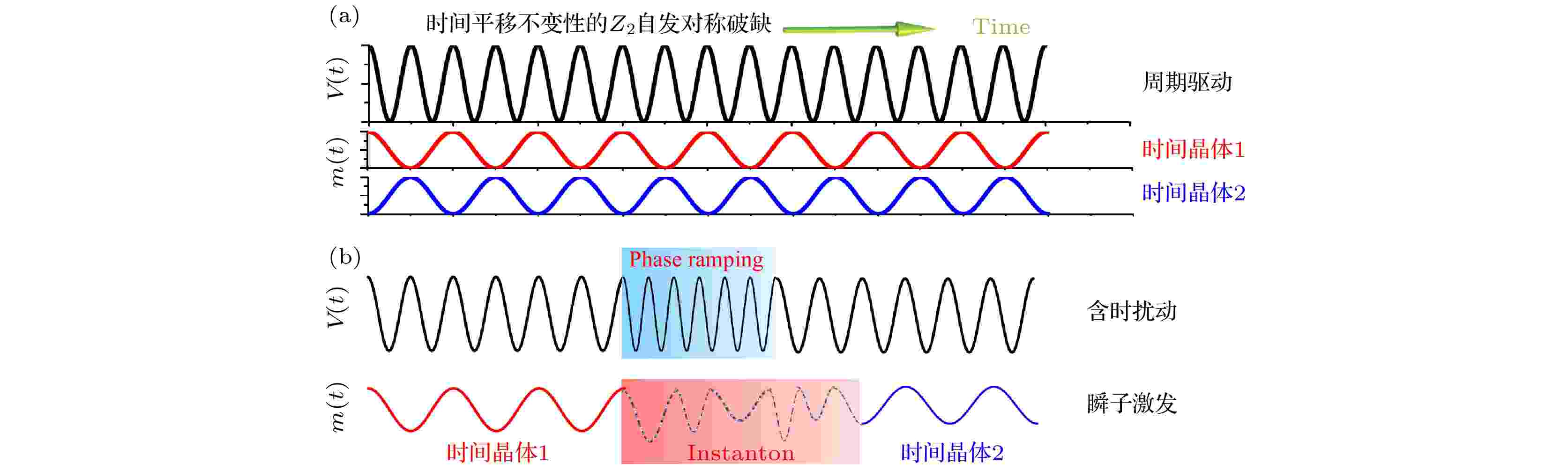
Non-equilibrium quantum many-body systems have attracted considerable attention in the past decades. The scope of the research of this kind of novel system involves interdisciplinary research of condensed matter, atomic and molecular physics, quantum optics, quantum information and quantum computation, as well as the non-equilibrium statistical physics. The non-equilibrium phenomena emerging from the aforementioned quantum systems can exhibit rich and universal behaviors, which have far from being well understood due to the novelties and complexities of these systems, and hence the quantum many-body physics becomes the research highlight. At the same time, with the rapid development of quantum techniques, the understanding of these complex systems is of important practical significance due to their potential applications in quantum computation and quantum manipulation. In this paper, we show our recent progress of non-equilibrium quantum many-body systems. We focus on the novel phenomena closely related to the temporary symmetry breaking, including the exotic quantum matter, quasi-particles as well as the dynamical universality classes in non-equilibrium quantum many-body systems.

2021, 70 (23): 230308.
doi: 10.7498/aps.70.20211556
Abstract +
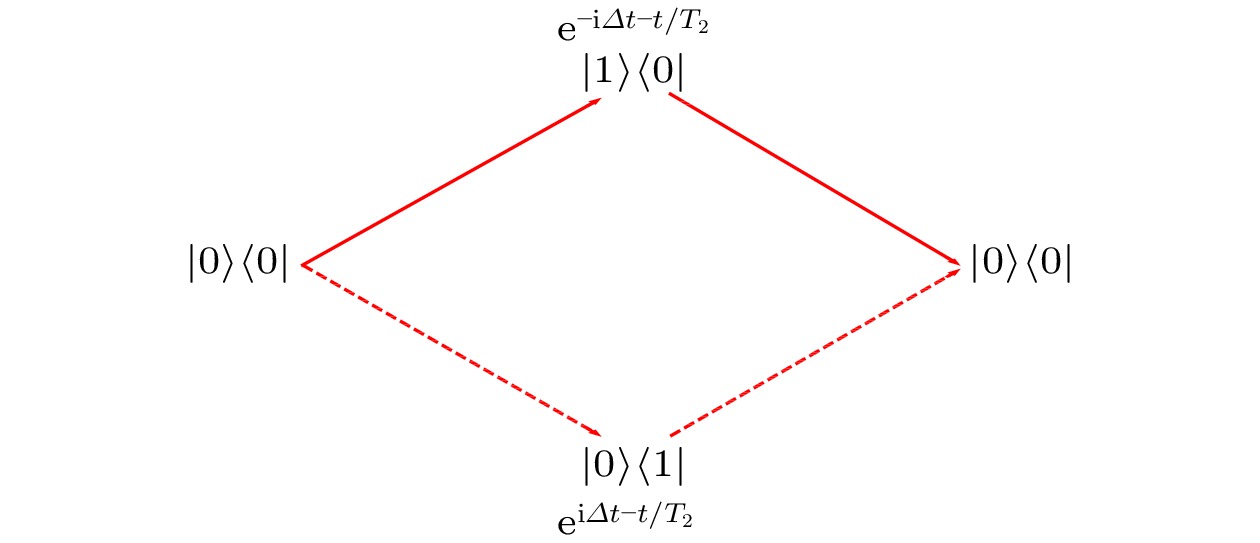
Two-dimensional coherent spectroscopy (2DCS) diagnoses a material’s nonlinear optical response with multiple time variables, thus offering information that is inaccessible with conventional linear optical spectroscopy. The 2DCS in the infrared, visible, and ultraviolet frequency range has yielded fruitful results in chemistry and biology. In the terahertz (THz) frequency window, 2DCS has shown its promise in the study of strongly-correlated electronic systems. As a guide to this rapidly developing field, we survey the current status of the theory of THz-2DCS in strongly-correlated electronic systems. We then introduce the basic concepts and theoretical methods of 2DCS, and analyze the main characteristics of the two-dimensional spectra. Finally, we summarize our latest theoretical research in this field.
2021, 70 (23): 230503.
doi: 10.7498/aps.70.20211723
Abstract +
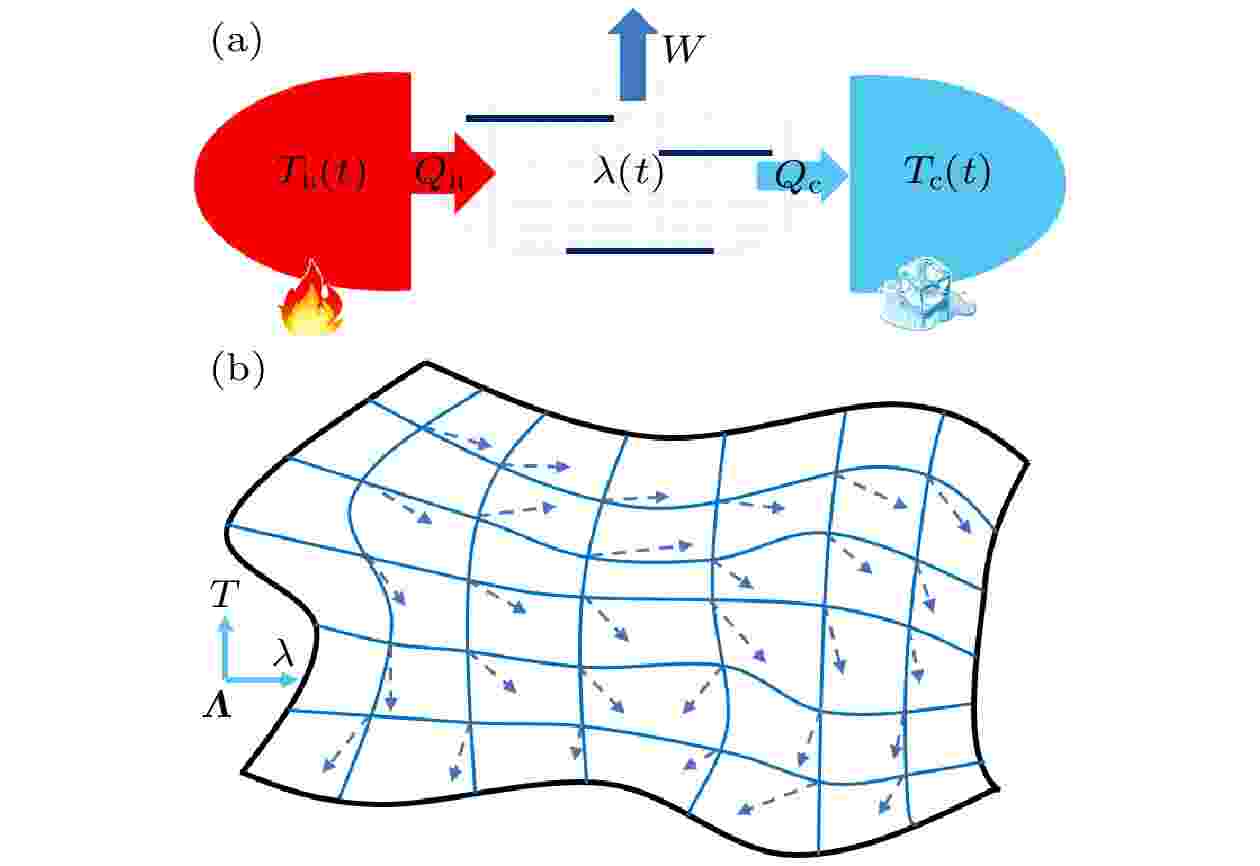
With the in-depth understanding of nano-/micro-scaled systems and the developing of the corresponding experimental techniques, the heat transport and energy conversion processes in these small systems have attracted much interest recently. In contrast to the static manipulation methods, which hinge on the steady nonequilibrium sources such as temperature bias, chemical potential difference, etc., the temporal driving methods can control small systems in nonequilibrium non-steady states with much more versatility and universality. The research on periodically driven small systems holds both fundamental and pragmatic promises. This review is based on the fundamental concept of geometry. By analyzing the geometric phase and thermodynamic length in the transport process and the energy conversion process, we provide a unified perspective for the recent researches on the thermodynamic properties of driven nonequilibrium quantum systems. Thermodynamic geometry not only is the intrinsic origin of the nontrivial transport and dissipation, but also provides us with an all-applicable theoretical framework. The discussion over the geometry would yield multiple thermodynamic constraints on the transport and energy conversion, and can naturally construct a general optimization method as well. This will conduce to a better understanding of functionality for nonequilibrium quantum many-body systems acting as thermal machines. Also, this will inspire people to design quantum thermal machines with simultaneously more ideal performance, i.e. higher efficiency, higher power and higher constancy.

2021, 70 (23): 230306.
doi: 10.7498/aps.70.20211687
Abstract +
With the recent development of experimental technology, the ability to control the dissipation in quantum many-body system is greatly enhanced. Meanwhile, many new breakthroughs are achieved in detecting the quantum states and others. All these advances make it necessary to establish a new theory for calculating the dissipative dynamics in strongly correlated sstems. Very recently, we found that by taking the interactions between the system and the bath as a perturbation, a systematic dissipative response theory can be established. In this new approach, the calculation of dissipative dynamics for any physical observables and the entropies can be converted into the calculation of certain correlation functions in initial states. Then we discuss how Markovian approximation at low temperature limit and at high temperature limit can be reached Also, we review the progress of the dissipative dynamics in open Bose-Hubbard model. In the fourth section, we review recent progress of entropy dynamics of quench dynamics of an open quantum system. Finally, we draw a conclusion and discuss possible development in the future.
2021, 70 (23): 230307.
doi: 10.7498/aps.70.20211908
Abstract +
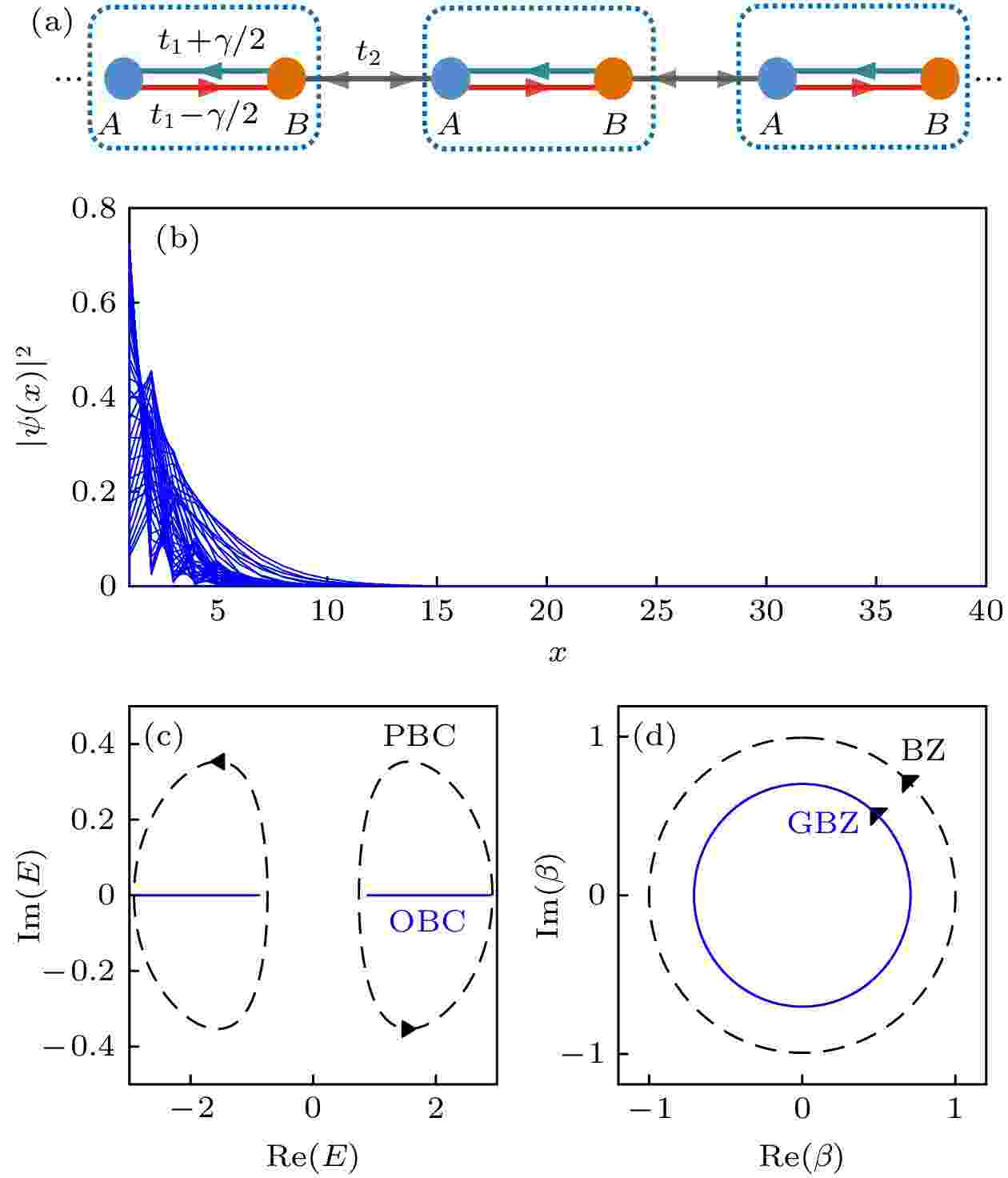
The energy band theory is one of the cornerstones of condensed matter physics. It also has wide applications in other branches of physics. Recently, a number of questions from non-Hermitian physics call for a generalization of energy band theory to non-Hermitian systems. In the study of non-Hermitian topological states, it has been found that such a generalization necessitates redefinitions of certain fundamental concepts of band theory. In particular, the non-Hermitian skin effect (NHSE) causes the breakdown of Bloch-band picture and conventional bulk-boundary correspondence. To calculate the energy spectra and define topological invariants, the standard Brillouin zone gives way to the generalized Brillouin zone (GBZ). Many intriguing non-Hermitian phenomena, including the non-Hermitian skin effect, can be precisely characterized in terms of the generalized Brillouin zone. The non-Hermitian band theory based on the concept of generalized Brillouin zone, now generally known as the non-Bloch band theory, has successfully described and predicted a number of novel non-Hermitian phenomena. The present article provides a brief introduction to the main concepts of non-Bloch band theory, and its applications in the non-Hermitian bulk-boundary correspondence, Green’s functions, wave dynamics, chiral damping, and non-Bloch parity-time symmetry.
2021, 70 (23): 230309.
doi: 10.7498/aps.70.20211576
Abstract +
2021, 70 (23): 230504.
doi: 10.7498/aps.70.20211836
Abstract +
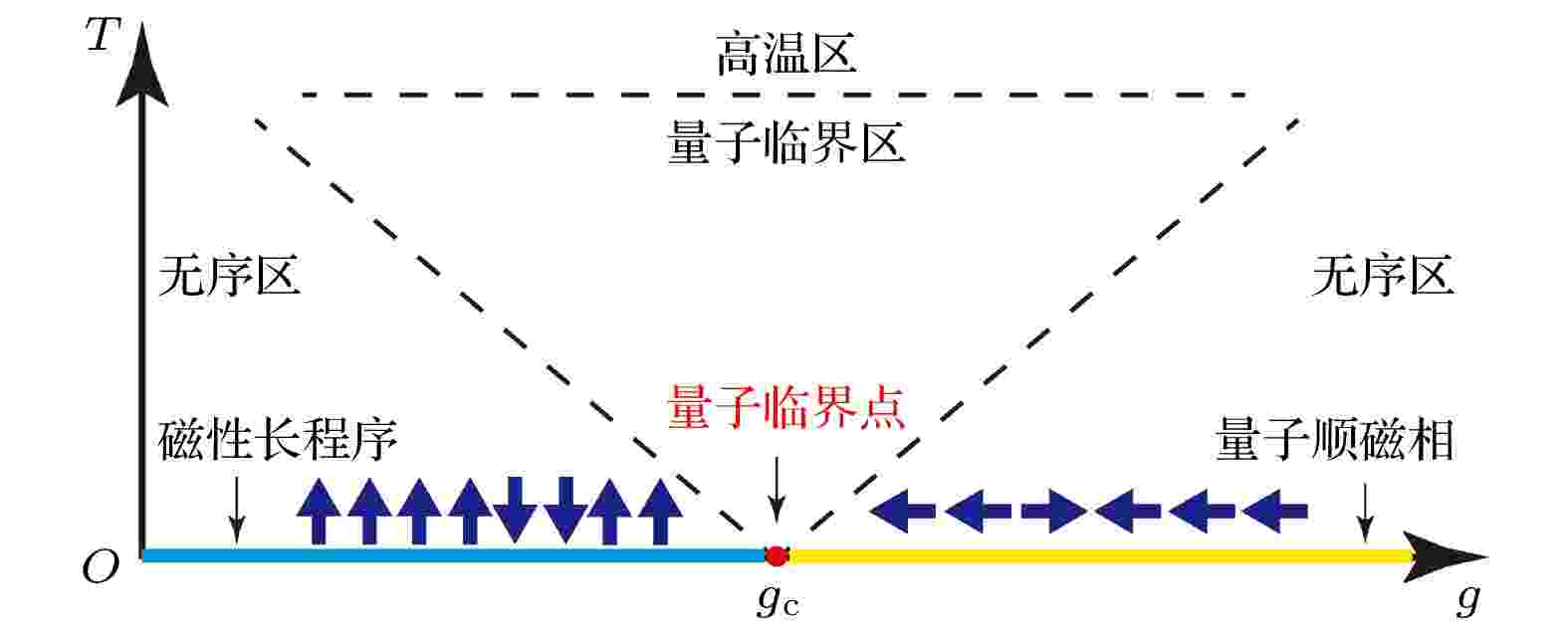
This review reports a series of theoretical and experimental progress on researches of the transverse field Ising chain (TFIC) and the quantum E8 integrable model. For the TFIC, on one hand, a unique exotic quantum critical behavior of Grüneisen ratio (a ratio from magnetic or thermal expansion coefficient to specific heat) is theoretically established; on the other hand microscopic models can accommodate the TFIC universality class are substantially expanded. These progresses successfully promote a series of experiments collaborations to first-time realize the TFIC universality class in quasi one-dimensional anti-ferromagnetic material BaCo2V2O8 and SrCo2V2O8. For the quantum E8 integrable model, the low temperature local dynamics and the dynamical structure factor with zero transfer momentum of this system are analytically determined, where a cascade of edge singularities with power-law divergences are obtained in the continuum region of the dynamical structure factor. After combining with detailed quantum critical scaling behaviors analysis and large scale iTEBD calculation, it successfully facilitates a series of experiments, including THz spectrum measurements, inelastic neutron scattering and NMR experiments, to realize the quantum E8 integrable model in BaCo2V2O8 for the first time. The experimental realization of the quantum E8 integrable model substantially extends the frontiers of studying quantum integrable models in real materials. The series of progress and developments on the TFIC and the quantum E8 integrable model lay down a concrete ground to go beyond quantum integrability, and can inspire studies in condensed matter systems, cold atom systems, statistical field theory and conformal field theory.

2022, 71 (8): 080301.
doi: 10.7498/aps.71.20220360
Abstract +
The high-fidelity multi-ion entangled states and quantum gates are the basis for trapped-ion quantum computing. Among the developed quantum gate schemes, Mølmer-Sørensen gate is a relatively mature experimental technique to realize multi-ion entanglement and quantum logic gates. In recent years, there have also been schemes to realize ultrafast quantum entanglement and quantum logic gates that operate outside the Lamb-Dicke regime by designing ultrafast laser pulse sequences. In such a many-body quantum system, these entanglement gates couple the spin states between ions by driving either the phonon energy level or the motional state of the ion chain. To improve the fidelity of quantum gates, the modulated laser pulses or the appropriately designed pulse sequences are applied to decouple the multi-mode motional states. In this review, we summarize and analyze the essential aspects of realizing these entanglement gates from both theoretical and experimental points of view. We also reveal that the basic physical process of realizing quantum gates is to utilize nonlinear interactions in non-equilibrium processes through driving the motional states of an ion chain with laser fields.
