














-
Measurement-device-independent quantum key distribution (MDI-QKD) protocol can effectively resist all possible attacks targeting the measurement devices in a quantum key distribution (QKD) system, thus exhibiting high security. However, due to the protocol’s high sensitivity to channel attenuation, its key generation rate and transmission distance are significantly limited in practical applications. To improve the performance of MDI-QKD, researchers have proposed quantum-memory (QM)-assisted MDI-QKD protocol, which has enhanced the protocol's performance to a certain extent. Nevertheless, under finite-size conditions where the total number of transmitted pulses is limited, accurately estimating the relevant statistical parameters is still a challenge. As a result, existing QM-assisted MDI-QKD schemes still encounters issues such as low key rates and limited secure transmission distances. To solve these problems, this work proposes a novel improved finite-size QM-assisted MDI-QKD protocol. By utilizing quantum memories to temporarily store early-arriving pulses and release them synchronously, the protocol effectively reduces the influence caused by channel asymmetry. Additionally, the protocol introduces a four-intensity decoy-state method to improve the estimation accuracy of single-photon components. Meanwhile, to mitigate the influence of finite-length effects on QM schemes, the proposed protocol combines a collective constraint model and a double-scanning algorithm to jointly estimate scanning error counts and vacuum-related counts. This approach enhances the estimation accuracy of the single-photon detection rate and phase error rate under finite-size conditions, thereby significantly improving the secure key rate of the MDI-QKD system. Simulation results show that under the same experimental conditions, compared with the existing QM-assisted three-intensity decoy-state MDI-QKD protocol and the four-intensity decoy-state MDI-QKD protocol based on Heralded Single-photon Source (HSPS), the proposed protocol extends the secure transmission distance by more than 30 km and 100 km, respectively. This proves that under the same parameter settings, the proposed scheme exhibits significant advantages in both key rate and secure transmission distance. Therefore, this research provides important theoretical references and valuable benchmarks for developing long-distance, high-security quantum communication networks. -
Keywords:
- quantum key distribution /
- quantum memory /
- double-scanning /
- joint constraints
-
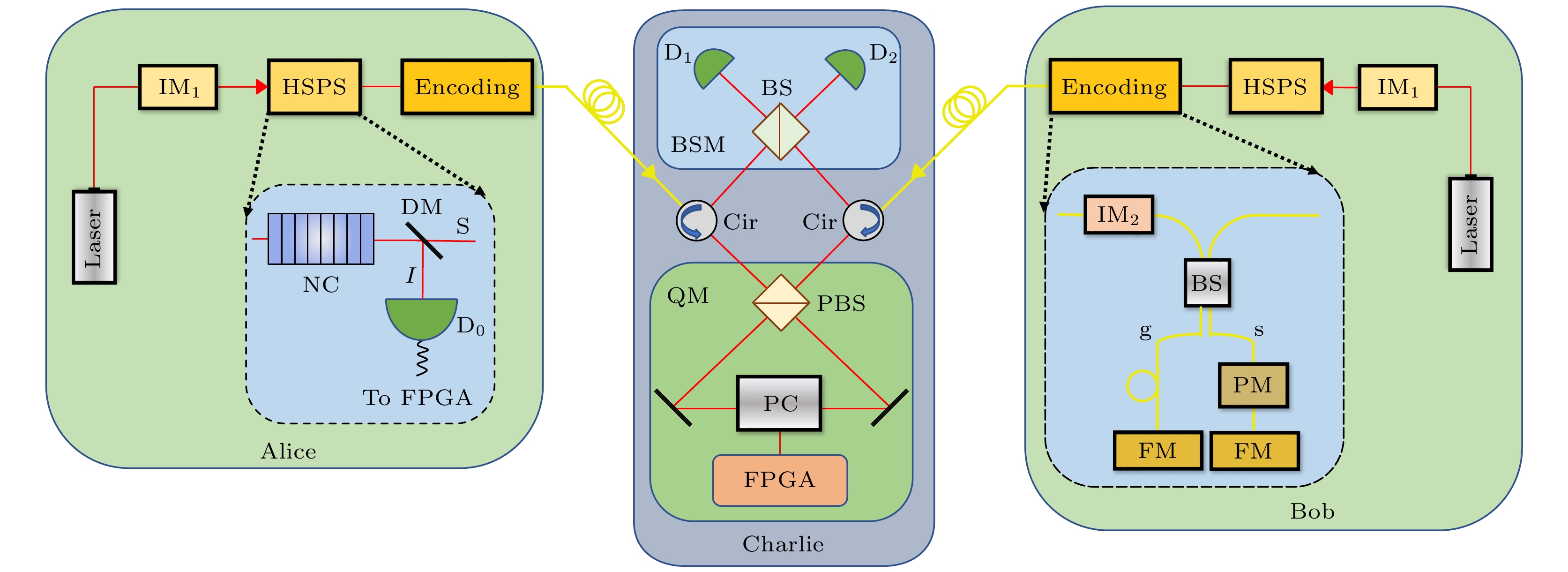
图 1 基于量子存储辅助的MDI-QKD系统装置示意图, 其中IM为强度调制器, NC为非线性晶体, DM为二色镜, PM为相位调制器, FM为法拉第反射镜, Cir为环形器, D0, D1, D2为单光子探测器, PC为泡克耳斯盒, BS为光束分离器, PBS为偏振光束分离器, BSM代表贝尔态测量装置, FPGA代表现场可编程逻辑门阵列
Figure 1. Schematic diagram of a quantum memory-assisted MDI-QKD system, where IM represents intensity modulator, NC represents nonlinear crystal, DM represents dichroic mirror, PM represents phase modulator, FM represents Faraday mirror, Cir represents circulator, D0, D1, D2 represent single-photon detectors, PC represents pockels cell, BS represents beam splitter, PBS represents polarization beam splitter, BSM represents Bell-state measurement device, FPGA represents field programmable gate array.
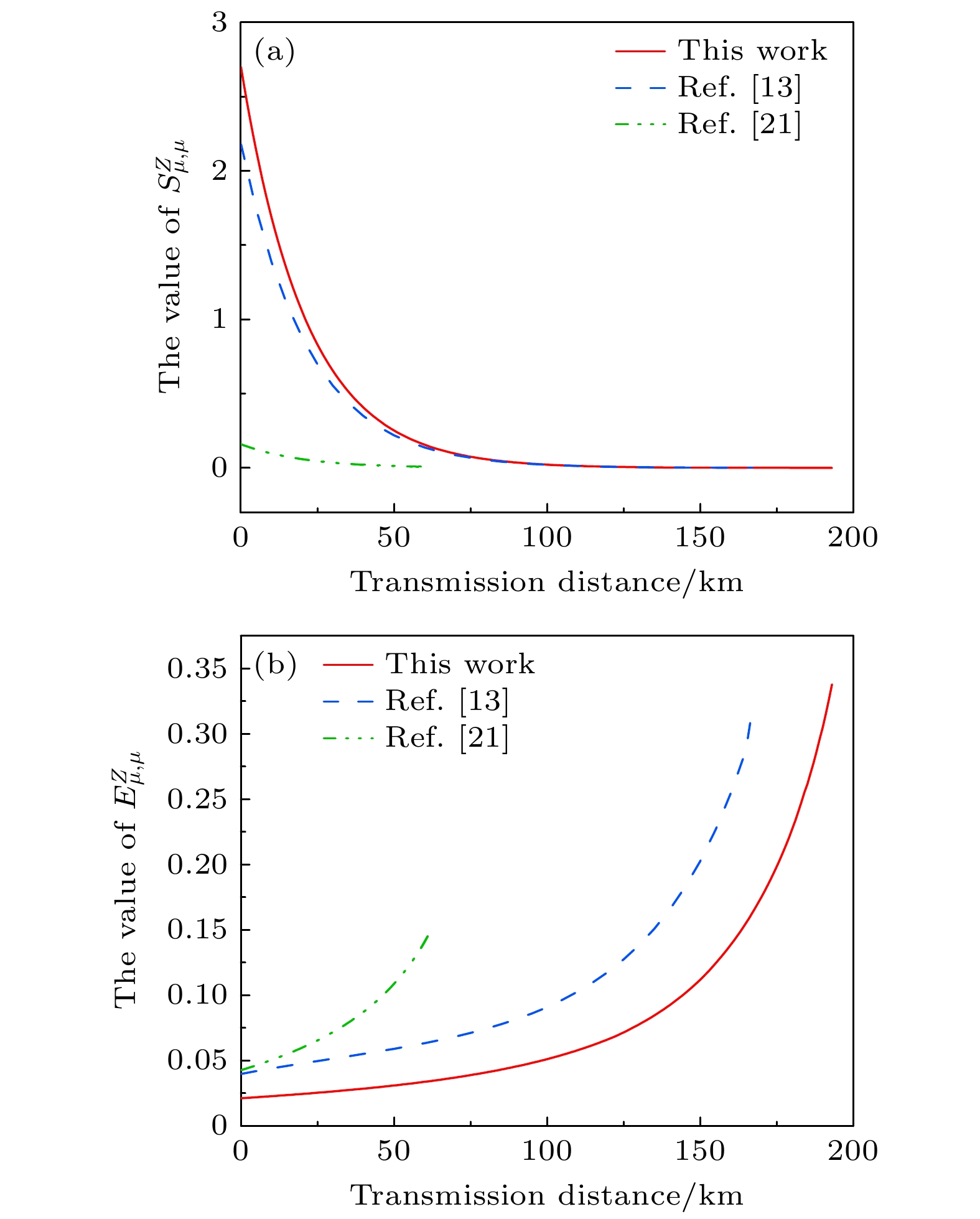
图 2 本文提出的方案与已有MDI-QKD方案的系统的增益$S_{{x_{\text{A}}}, {y_{\text{B}}}}^K$ (a) 和误码率$ E_{{x_{\text{A}}}, {y_{\text{B}}}}^K $(b) 曲线对比. 总脉冲数$N = {10^{10}}$
Figure 2. Comparison of the system gain $S_{{x_{\text{A}}}, {y_{\text{B}}}}^K$ (a) and quantum bit-error rate $ E_{{x_{\text{A}}}, {y_{\text{B}}}}^K $ (b) between the proposed scheme and existing MDI-QKD schemes. Total number of pulses $N = {10^{10}}$.
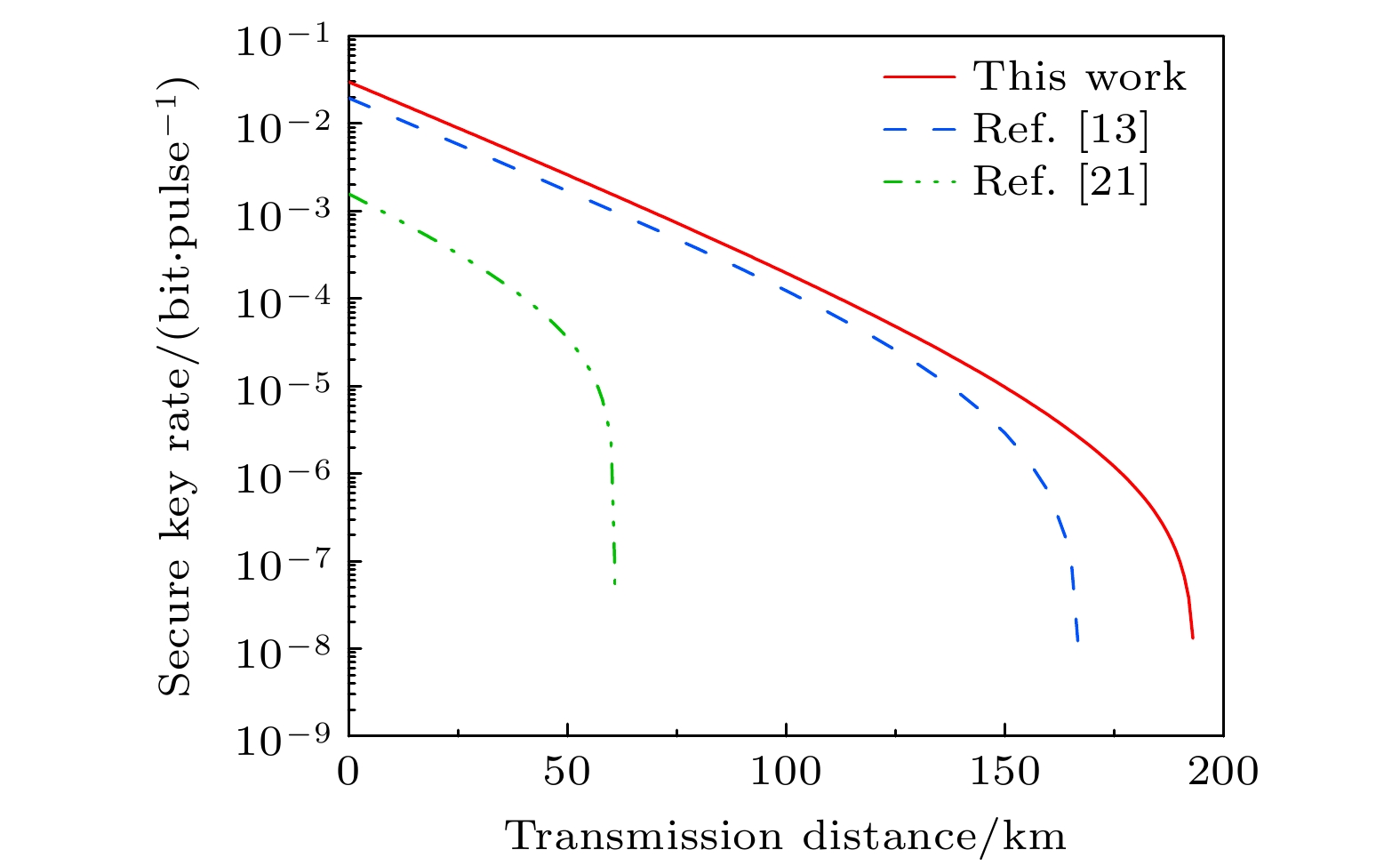
图 3 本文提出的方案与已有MDI-QKD方案的密钥率曲线对比. 总脉冲数$N = {10^{10}}$, 存储轮数$M = 20$
Figure 3. Comparison between the proposed scheme and existing MDI-QKD schemes. Total number of pulses $N = {10^{10}}$, and the number of storage rounds $M = 20.$
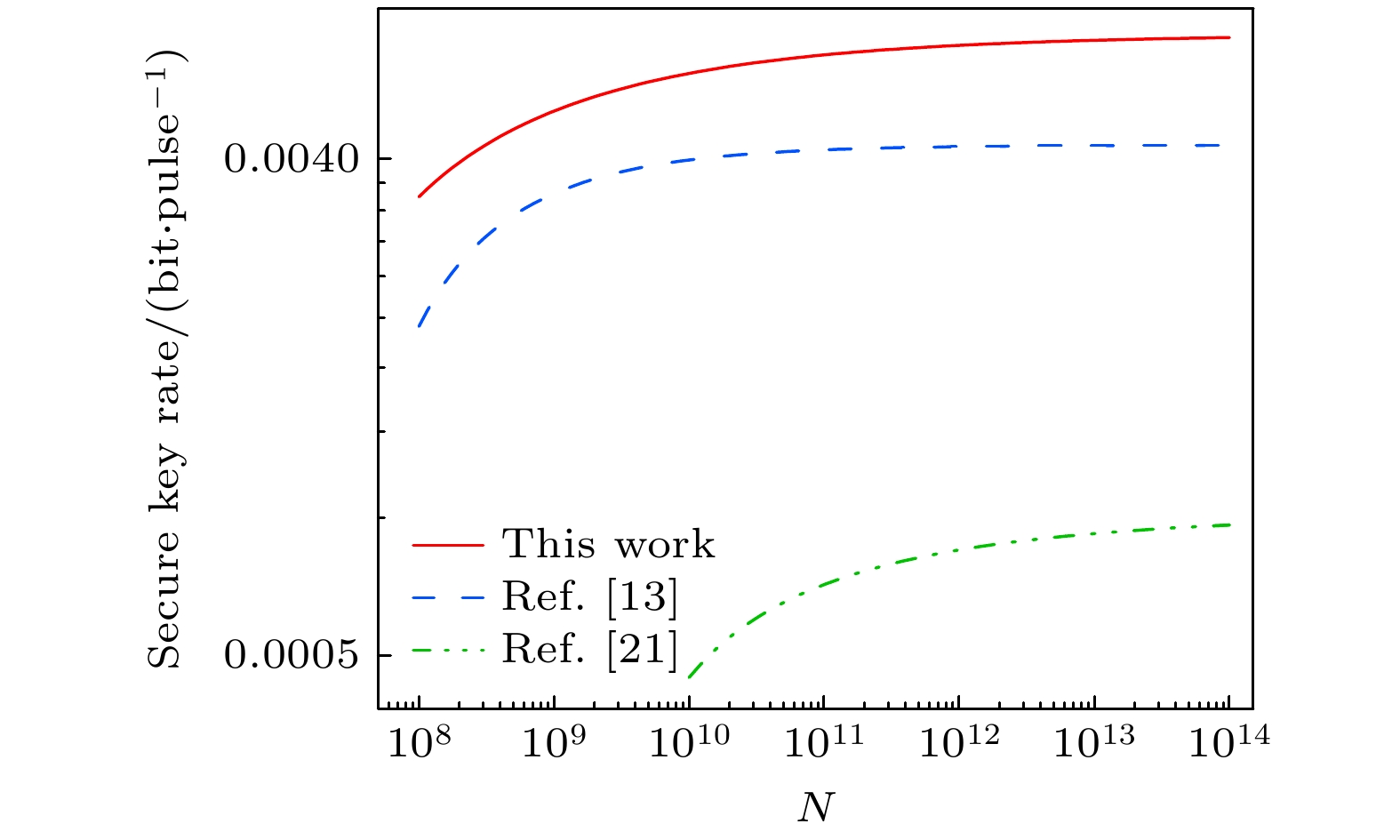
图 4 有限长效应对不同方案的影响. 存储轮数$M = 10$
Figure 4. Comparison of the impact of finite-size effects on different QKD schemes. Number of storage rounds $M = 10.$
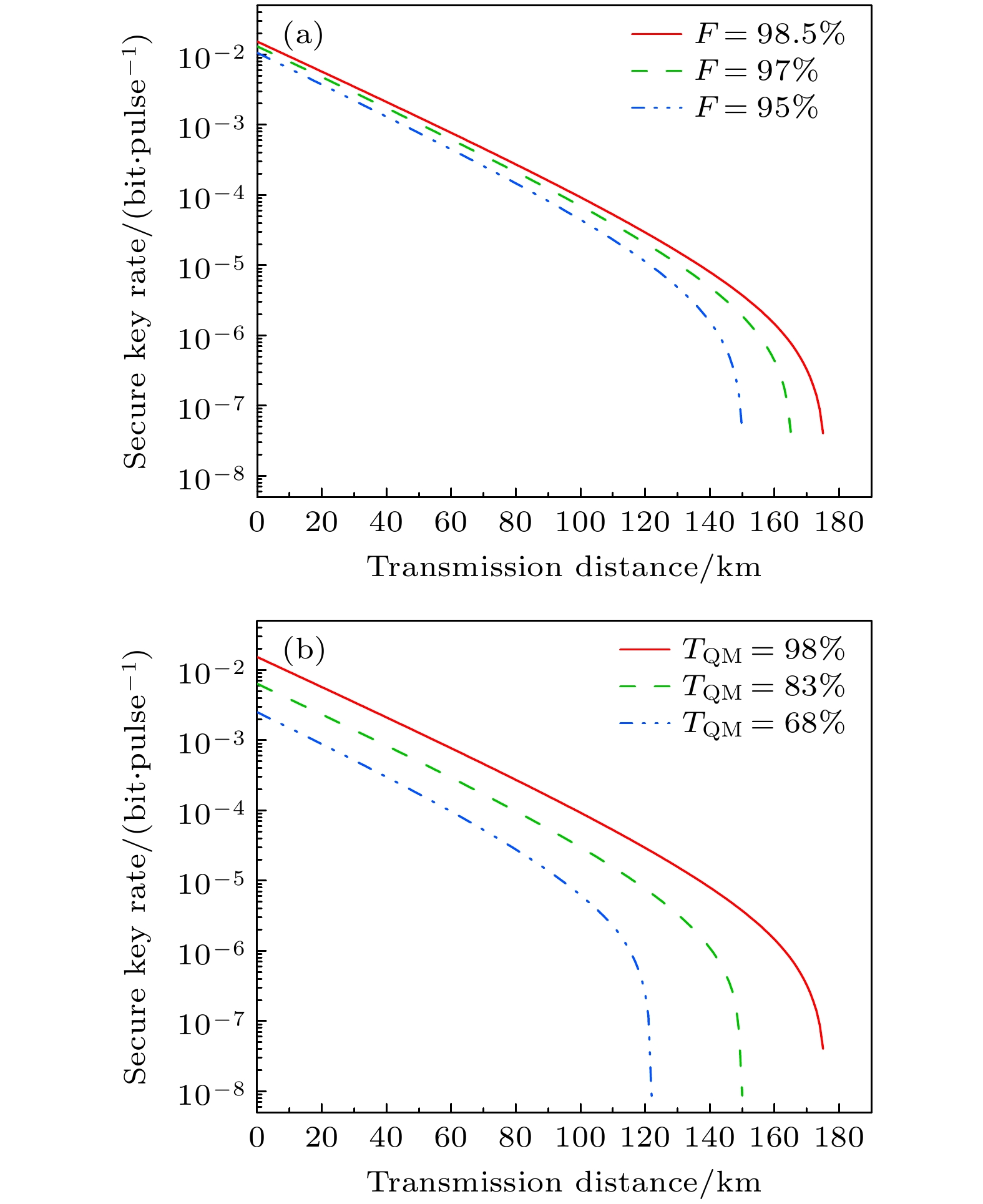
图 5 在不同存储保真度 (a) 与存储效率(b) 下密钥率随传输距离的变化. 存储轮数$M = 10$, 总脉冲数$N = {10^{10}}$
Figure 5. Variation of the key rate with transmission distance under (a) different storage fidelities and (b) different storage efficiencies. Number of storage rounds $M = 10$, and the total number of pulses $N = {10^{10}}$.
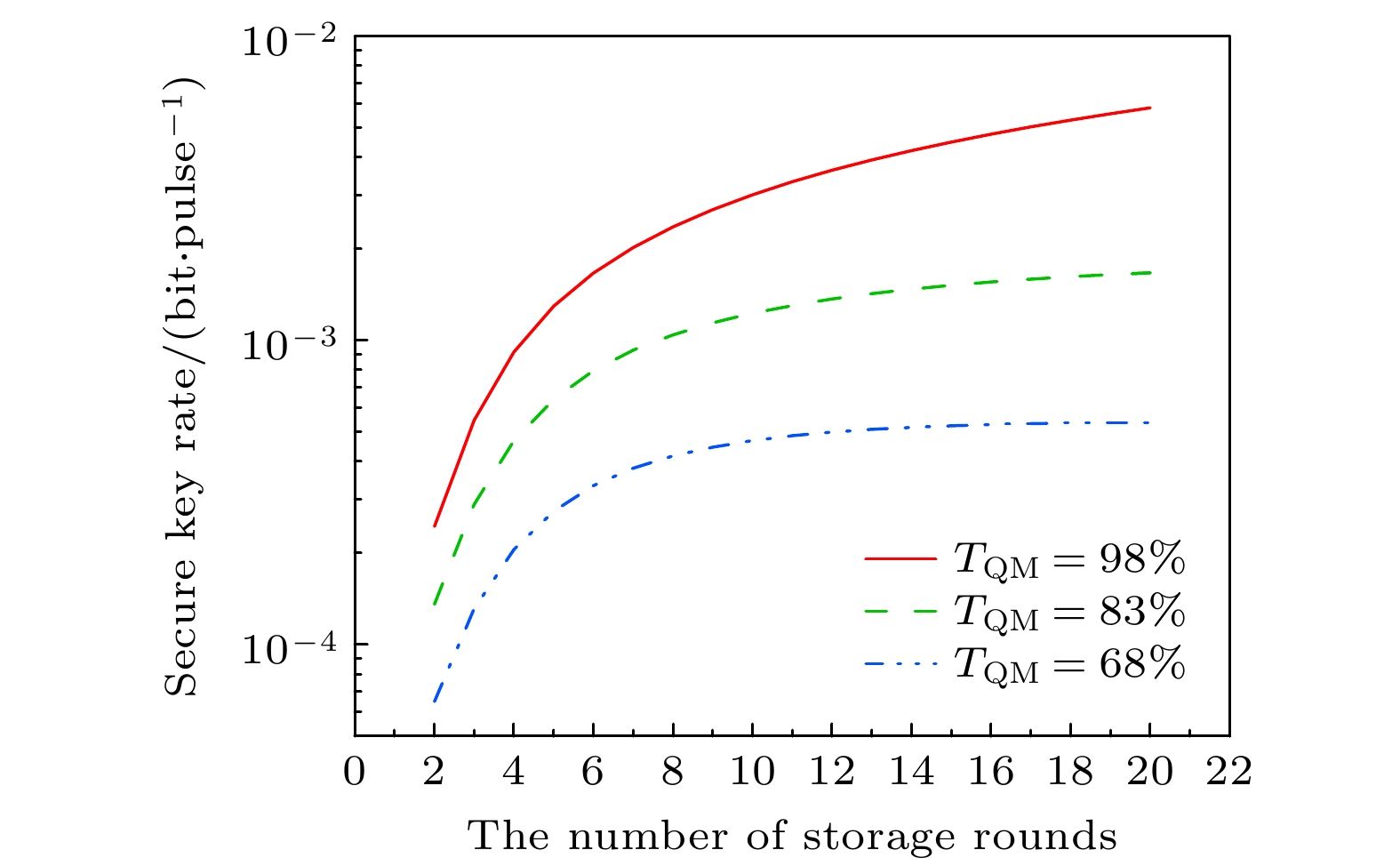
图 6 不同存储效率下密钥率随存储轮数的变化. 总脉冲数$N = {10^{10}}$
Figure 6. Variation of the key rate with the number of storage rounds under different storage efficiencies. Total number of pulses $N = {10^{10}}$.
表 1 基于量子存储的四强度诱骗态MDI-QKD协议仿真使用的参数
Table 1. Simulation parameters used in the quantum-memory-based four-intensity decoy-state MDI-QKD protocol.
${e_{\text{d}}}$ $Pd$ $P{d_{\text{t}}}$ ${\eta _{\text{d}}}$ ${\eta _{\text{t}}}$ $\xi $ $f$ $\alpha $/(dB·km–1) $0.015$ $ {10^{ - 7}} $ ${10^{ - 7}}$ $0.6$ $0.75$ ${10^{ - 10}}$ $1.16$ $0.2$  DownLoad: CSV
-
[1] Bennett C H, Brassard G 1984 Proceedings of IEEE International Conference on Computers, System and Signal Processing (Vol. 1 of 3) (Bangalore: IEEE) p175
[2] Lo H K, Curty M, Qi B 2012 Phys. Rev. Lett. 108 130503
 Google Scholar
[3] Zhou Y H, Yu Z W, Wang X B 2016 Phys. Rev. A 93 042324
Google Scholar
[4] Yin H L, Chen T Y, Yu Z W, Liu H, You L X, Zhou Y H, Chen S J, Mao Y, Huang M Q, Zhang W J et al. 2016 Phys. Rev. Lett. 117 190501
Google Scholar
[5] Jiang C, Yu Z W, Hu X L, Wang X B 2021 Phys. Rev. A 103 012402
Google Scholar
[6] Chen Y P, Liu J Y, Sun M S et al. 2021 Opt. Lett. 46 3729
Google Scholar
[7] Chanelière T, Matsukevich D, Jenkins S, Lan S Y, Kennedy T A B, Kuzmich A 2005 Nature 438 833
Google Scholar
[8] Panayi C, Razavi M, Ma X F, Lütkenhaus N 2014 New J. Phys. 16 043005
Google Scholar
[9] Piparo N L, Razavi M, Panayi C 2015 IEEE J. Sel. Top. Quantum Electron. 21 138
Google Scholar
[10] Pittman T B, Franson J D 2002 Phys. Rev. A 66 062302
Google Scholar
[11] Evans C J, Nunn C M, Cheng S W L, Franson J D, Pittman T B 2023 Phys. Rev. A 108 L050601
Google Scholar
[12] Sun M S, Zhang C H, Luo Y Z, Wang S, Liu Y, Li J, Wang Q 2025 Appl. Phys. Lett. 126 104001
Google Scholar
[13] Sun M S, Zhang C H, Ding H J, Zhou X Y, Li J, Wang Q 2023 Phys. Rev. Appl. 20 024029
Google Scholar
[14] Wang Q, Karlsson A 2007 Phys. Rev. A 76 014309
Google Scholar
[15] Mo X F, Zhu B, Han Z F, Gui Y Z, Guo G C 2005 Opt. Lett. 30 2632
Google Scholar
[16] Goswami I, Mandal M, Mukhopadhyay S 2022 J. Opt. 51 379
Google Scholar
[17] Kaneda F, Xu F H, Chapman J, Kwiat P G 2017 Optica 4 1034
Google Scholar
[18] Yu Z W, Zhou Y H, Wang X B 2015 Phys. Rev. A 91 032318
Google Scholar
[19] Wang Q, Wang X B 2014 Sci. Rep. 4 4612
Google Scholar
[20] Curty M, Xu F H, Cui W, Lim C C W, Tamaki K, Lo H K 2014 Nat. Commun. 5 4732
Google Scholar
[21] Zhou X Y, Zhang C H, Zhang C M, Wang Q 2017 Phys. Rev. A 96 052337
Google Scholar
[22] Ren Z A, Chen Y P, Liu J Y, Ding H J, Wang Q 2021 IEEE Commun. Lett. 25 940
Google Scholar
[23] Xu J X, Ma X, Liu J Y, Zhang C H, Li H W, Zhou X Y, Wang Q 2024 Sci. China Inf. Sci. 67 202501
Google Scholar
[24] Duan L M, Lukin M, Cirac L, Zoller P 2001 Nature 414 413
Google Scholar
[25] Duan L M, Cirac J I, Zoller P 2002 Phys. Rev. A 66 023818
Google Scholar
[26] Gujarati T P, Wu Y K, Duan L M 2018 Phys. Rev. A 97 033826
Google Scholar
[27] Li X K, Song X Q, Guo Q W, Zhou X Y, Wang Q 2021 Chin. Phys. B 30 060305
Google Scholar
[28] Abruzzo S, Kampermann H, Bruß D 2014 Phys. Rev. A 89 012301
Google Scholar
[29] Jozsa R 1994 J. Mod. Opt. 41 2315
Google Scholar

 DownLoad:
Metrics
- Abstract views: 20
- PDF Downloads: 0
- Cited By: 0
