














-
90°optical mixer, as an essential part of coherent optical communication and heterodyne detection, improves polarization discrimination and anti-interference capabilities, increases receiver sensitivity, and permits demodulation of higher-order modulation forms. The disadvantages of traditional 90° optical mixers, however, include their high precision needs, size, mode mismatch restrictions, polarization sensitivity, and single functionality. Utilizing a lithium niobate platform, a multimode interference (MMI) structure, and a micro-thermoelectric electrode array, and with the help of the finite difference time domain (FDTD) method, a multipurpose device that combines 90° optical mixing and mode separation capabilities is designed in this work. According to the results, when no voltage is applied across the micro-thermoelectric electrodes, the multipurpose device acts as a 90° optical mixer. The common-mode rejection ratios of all four outputs are all above –30 dB, phase errors are below 4°, and the losses in the wavelength range of 1520–1580 nm exceed –13.862 dB. When a voltage is applied across the micro-thermoelectric electrodes, TE0, TE1, TE2, and TE3 modes are separated by the multipurpose device acting as a mode splitter. In addition to controlling crosstalk fluctuation within 8.8 dB, the minimum loss divergence between modes is less than 0.024 dB. Research findings indicate that the physical characteristics of optical field interference within the MMI structure enable perfect phase matching and energy distribution across a wide spectrum range, even when no voltage is supplied across the micro-thermoelectric electrode terminals. By controlling the interference superposition process inside the multi-mode region and improving broadband 90° optical mixing parameters, the stable phase-matching conditions are maintained across the wide spectrum. The lithium niobate-based linear electro-optic effect (Pockels effect) modifies the waveguide refractive index distribution through an external electric field when a voltage is applied across the micro-thermoelectrodes. By changing the light field’s coupling path and propagation mode inside the MMI structure, the mode-separating integrator can precisely achieve mode separation, thereby confirming the efficiency of the electro-optic effect in optical functional control, which meets the isolation requirements for various mode optical signals. Furthermore, a systematical tolerance analysis of the device’s width and length is carried out, demonstrating how structural dimensional deviations affect the mode coupling efficiency and optical field interference circumstances. The integrated broadband 90° optical mixer and mode splitter device described in this paper has excellent process tolerance properties.
[1] 韩笑天, 聂文超, 李鹏, 李广英, 常畅, 张鹏飞, 廖佩璇, 谢琛华, 李慧, 汪伟, 谢小平 2025 光学学报 45 1306016
 Google Scholar
Han X T, Nie W C, Li P, Li G Y, Chang C, Zhang P F, Liao P X, Xie C H, Li H, Wang W, Xie X P 2025 Acta Opt. Sin. 45 1306016
Google Scholar
[2] Xing J J, Li Z Y, Xiao X, Yu J Z, Yu Y D 2013 Opt. Lett. 38 3468
Google Scholar
[3] 马天宝, 祁玲珍, 彭姝, 李佳明, 郭旭联, 刘奎 2024 光学学报 44 1627001
Google Scholar
Ma T B, Qi L Z, Peng S, Li J M, Guo X L, Liu K 2024 Acta Opt. Sin. 44 1627001
Google Scholar
[4] Driscoll J B, Grote R R, Souhan B, Dadap J I, Lu M, Osgood R M 2013 Opt. Lett. 38 1854
Google Scholar
[5] Halir R, Molina-Fernández I, Ortega-Moñux A, Wangüemert-Pérez J G, Xu D X, Cheben P, Janz S 2008 J. Lightwave Technol. 26 2697
Google Scholar
[6] Jeong S H, Morito K 2010 J. Lightwave Technol. 28 1323
Google Scholar
[7] Voigt K, Zimmermann L, Winzer G, Tian H, Tillack B, Petermann K 2011 IEEE Photonics Technol. Lett. 23 1769
Google Scholar
[8] Halir R, Roelkens G, Ortega-Moñux A, Wangüemert-Pérez J G 2011 Opt. Lett. 36 178
Google Scholar
[9] Yang W, Yin M, Li Y P, Wang X J, Wang Z Y 2013 Opt. Express 21 28423
Google Scholar
[10] Liao J W, Zhang L X, Liu M L, Wang L R, Wang W Q, Wang G X, Ruan C, Zhao W, Zhang W F 2016 IEEE Photonics Technol. Lett. 28 2597
Google Scholar
[11] Jiang W F, Wang X G 2020 J. Lightwave Technol. 38 2414
Google Scholar
[12] Liu D J, Zhang M, Shi Y C, Dai D X 2020 IEEE Photonics Technol. Lett. 32 192
Google Scholar
[13] Jiang W F, Xu S Y 2021 J. Lightwave Technol. 39 6239
Google Scholar
[14] Chen T, Dang Z Q, Liu Z X, Ding Z M, Yang Z F, Zhang X D, Jiang X H, Zhang Z Y 2021 IEEE Photonics Technol. Lett. 33 1135
Google Scholar
[15] 陈涛, 毛思强, 万洪丹, 汪静丽, 蒋卫锋 2023 光学学报 43 2313003
Google Scholar
Chen T, Mao S Q, Wan H D, Wang J L, Jiang W F 2023 Acta Opt. Sin. 43 2313003
Google Scholar
[16] 廖莎莎, 张伍浩, 赵帅, 赵薪程, 唐亮 2024 光学学报 44 0523001
Google Scholar
Liao S S, Zhang W H, Zhao S, Zhao X C, Tang L 2024 Acta Opt. Sin. 44 0523001
Google Scholar
[17] 王曼卓, 姚振涛, 孙朝阳, 张越, 方记民, 孙小强, 吴远大, 张大明 2025 光子学报 54 0323001
Google Scholar
Wang M Z, Yao Z T, Sun C Y, Zhang Y, Fang J M, Sun X Q, Wu Y D, Zhang D M 2025 Acta Photonica Sin. 54 0323001
Google Scholar
[18] Qi Y, Li Y 2020 Nanophotonics 9 1287
Google Scholar
[19] 徐光耀, 马晓飞, 盛冲, 刘辉 2023 光学学报 43 1923001
Google Scholar
Xu G Y, Ma X F, Chong S, Liu H 2023 Acta Opt. Sin. 43 1923001
Google Scholar
[20] 冯新凯, 陈怀熹, 陈家颖, 梁万国 2023 中国激光 50 2208001
Google Scholar
Feng X K, Chen H X, Chen J Y, Liang W G 2023 Chin. J. Lasers 50 2208001
Google Scholar
[21] Guan H, Ma Y J, Shi R Z, Zhu X L, Younce R, Chen Y J, Roman J, Ophir N, Liu Y, Ding R, Baehr-Jones T, Bergman K, Hochberg M 2017 Opt. Express 25 28957
Google Scholar
[22] Ortega-Monux A, Zavargo-Peche L, Maese-Novo A, Molina-Fernandez I, Halir R, Wanguemert-Perez J G, Cheben P, Schmid J H 2011 IEEE Photonics Technol. Lett. 23 1406
Google Scholar
-
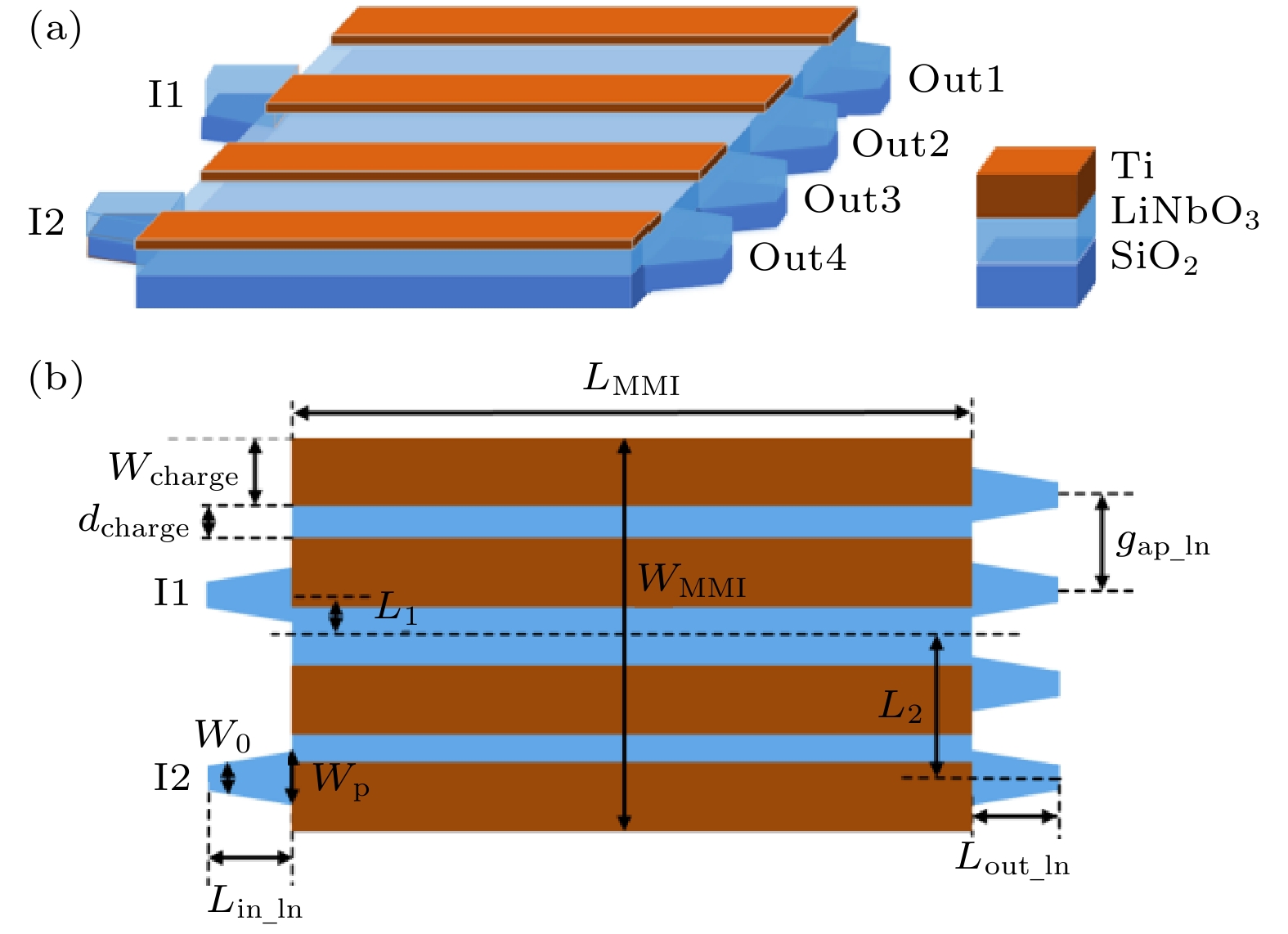
图 1 宽带90°光混频器的示意图 (a) 三维图; (b) 俯视图
Figure 1. Schematic diagram of a wideband 90° optical mixer: (a) Three-dimensional diagram; (b) top view.
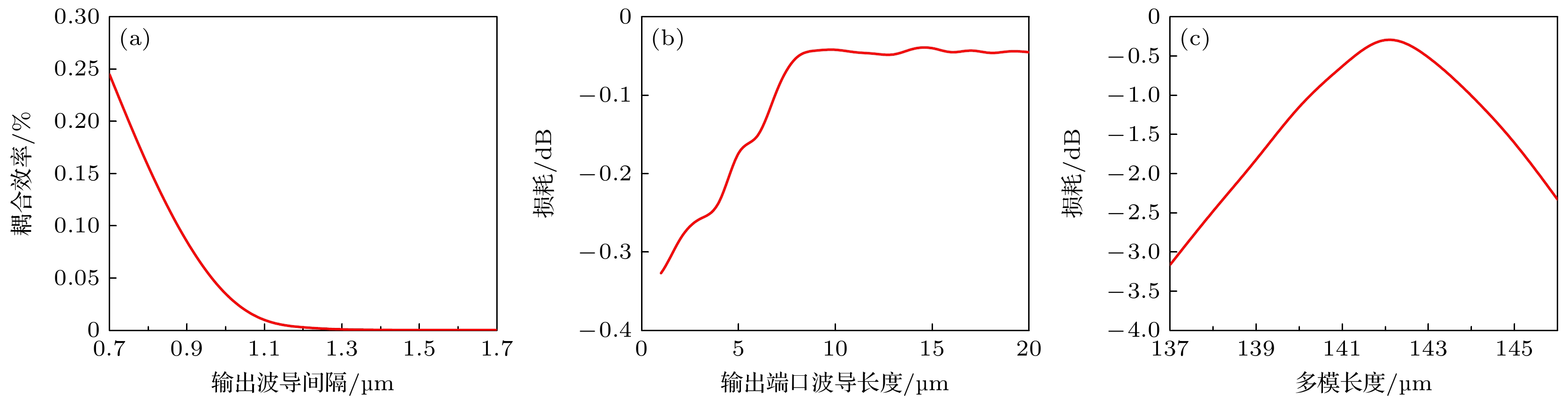
图 2 性能随结构参数变化曲线 (a) 耦合效率随输出波导间隔gap_ln的变化; (b) 损耗随输出端波导长度Lout-ln的变化; (c) 损耗随多模波导长度LMMI的变化
Figure 2. Performance curves with structural parameters: (a) Curve of coupling efficiency with output waveguide gap_ln; (b) variation of loss with output waveguide length Lout-ln; (c) variation of loss with multimode waveguide length LMMI.
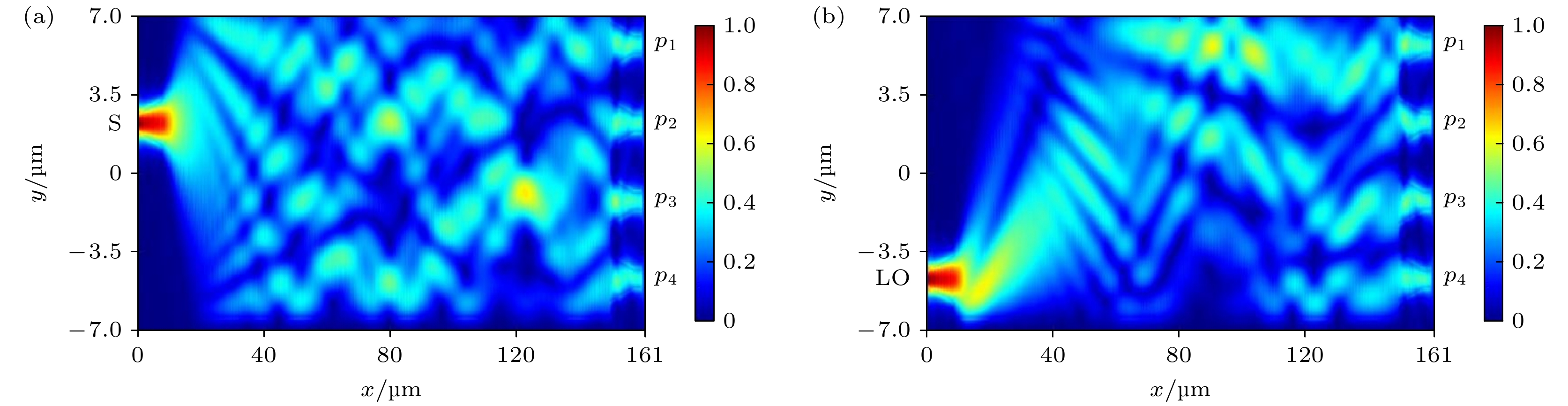
图 3 基于LiNbO3平台宽带90°光混频器单束光输入光强图 (a) 单束信号光输入; (b) 单束本振光输入
Figure 3. Single-beam optical input light intensity diagram of a wideband 90° optical mixer based on the LiNbO3 platform: (a) Single beam signal light input; (b) single-beam local oscillator optical input.
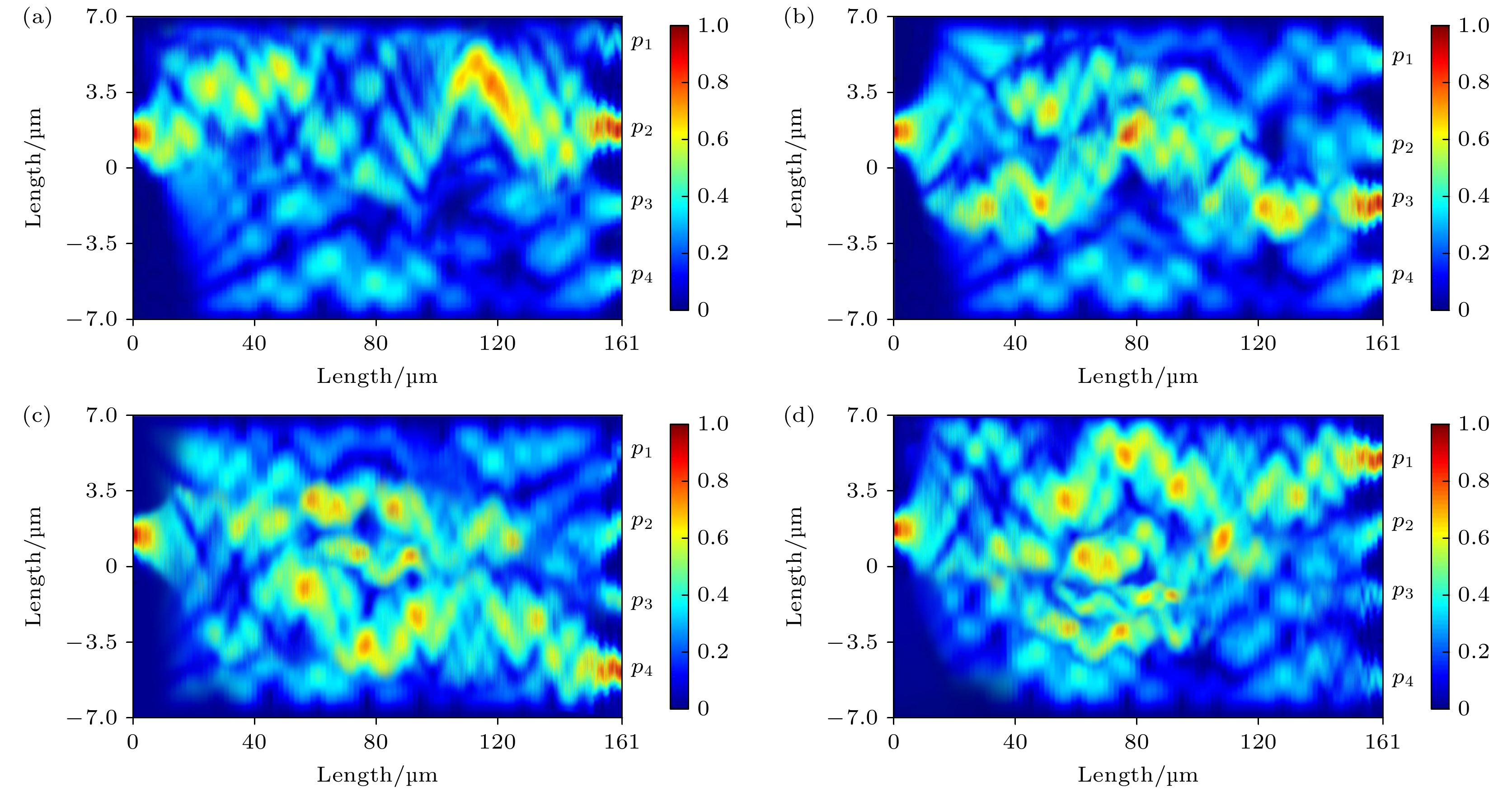
图 4 各模式传输光场图 (a) 输出TE0模式; (b) 输出TE1模式; (c) 输出TE2模式; (d) 输出TE3模式
Figure 4. Transmission light field diagram of each mode: (a) Outputs TE0 mode; (b) outputs TE1 mode; (c) output TE2 mode; (d) output TE3 mode.
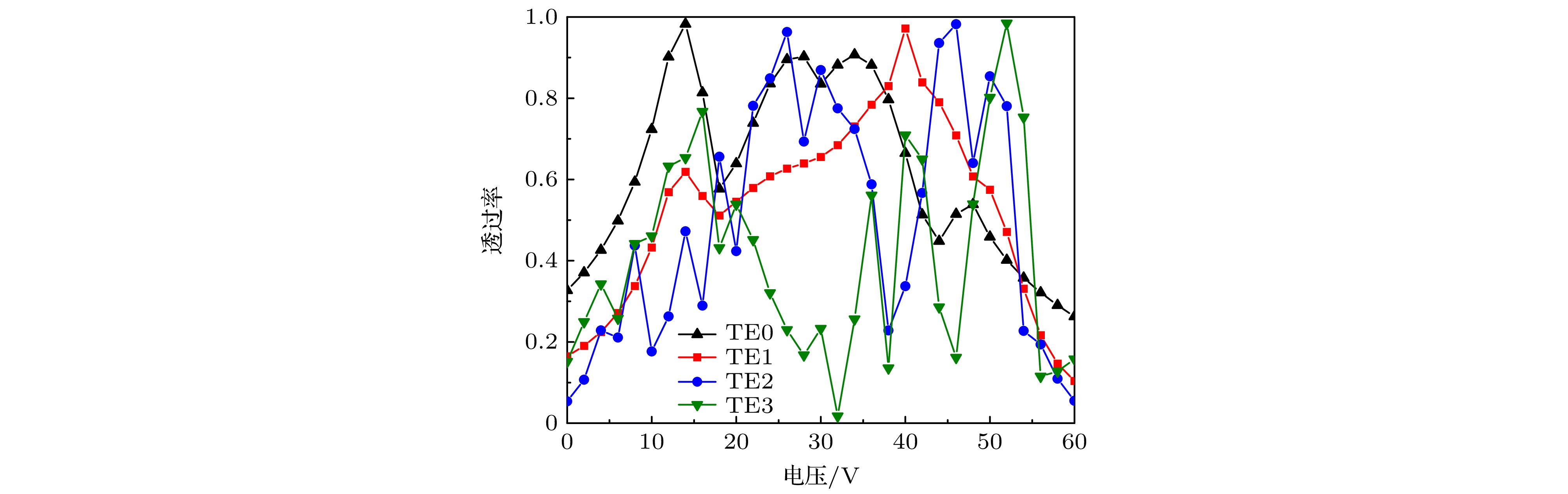
图 5 各模式透射率随电压变化曲线
Figure 5. Variation curves of transmittance with voltage in each mode.
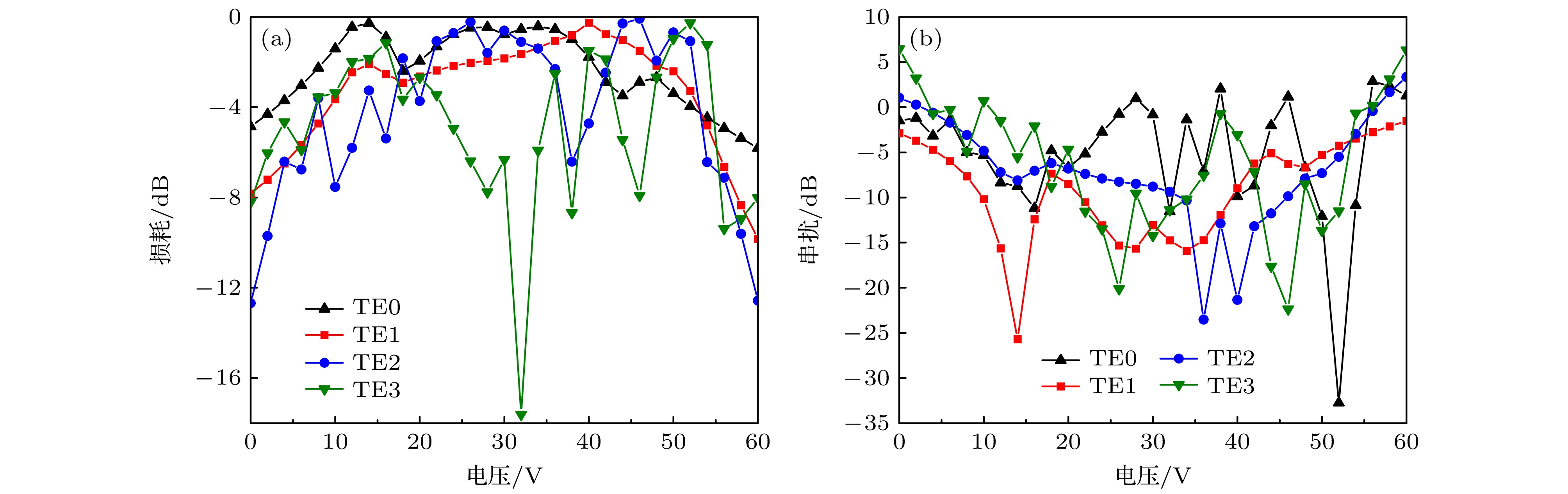
图 6 各模式性能指标随电压变化曲线 (a) 模式分离器损耗; (b) 模式分离器串扰
Figure 6. Variation curves of performance index of each mode with voltage: (a) Mode separator loss; (b) mode separator crosstalk.
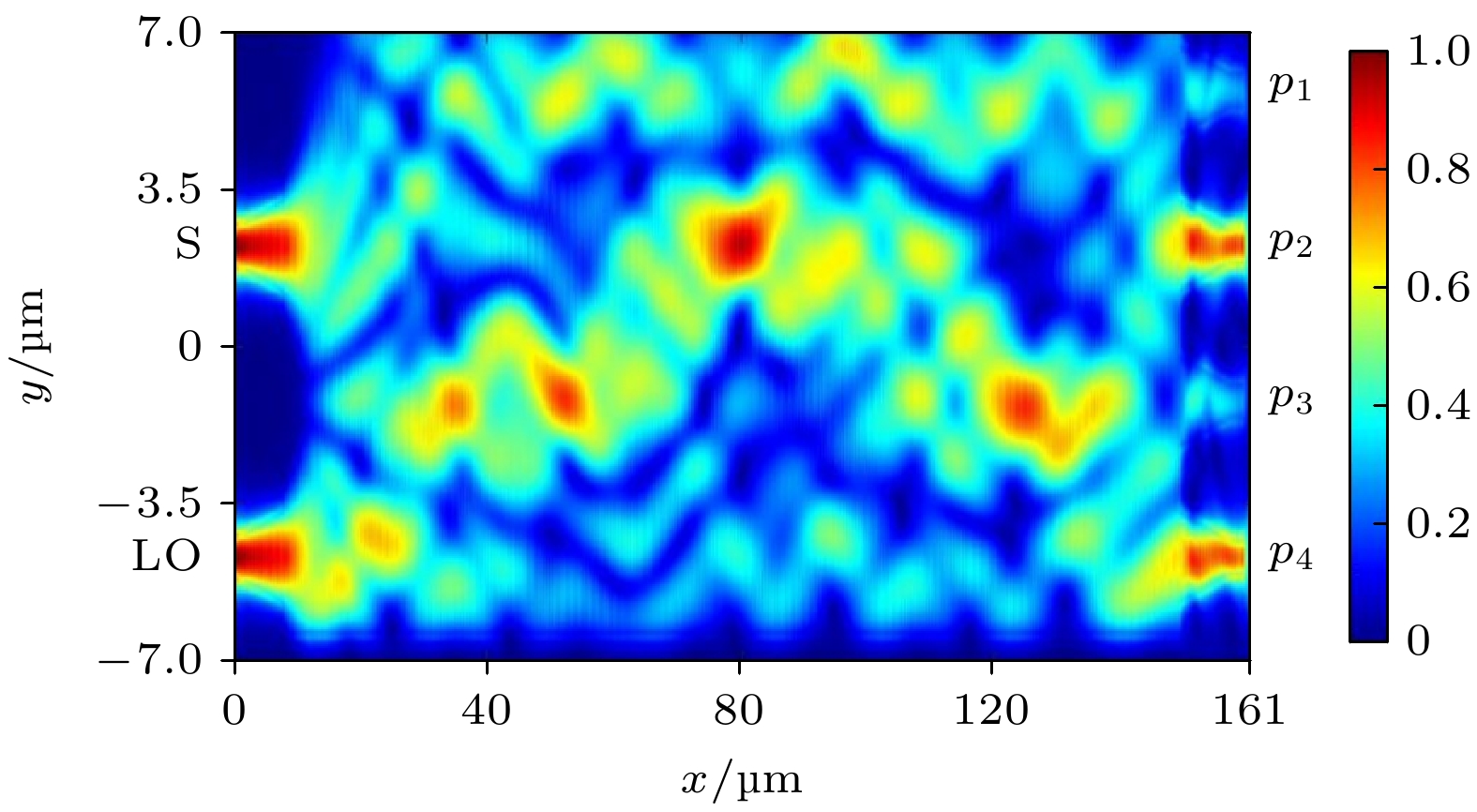
图 7 基于LiNbO3平台的宽带90°光混频器光强图
Figure 7. Light intensity map of a wideband 90° optical mixer based on LiNbO3 platform.
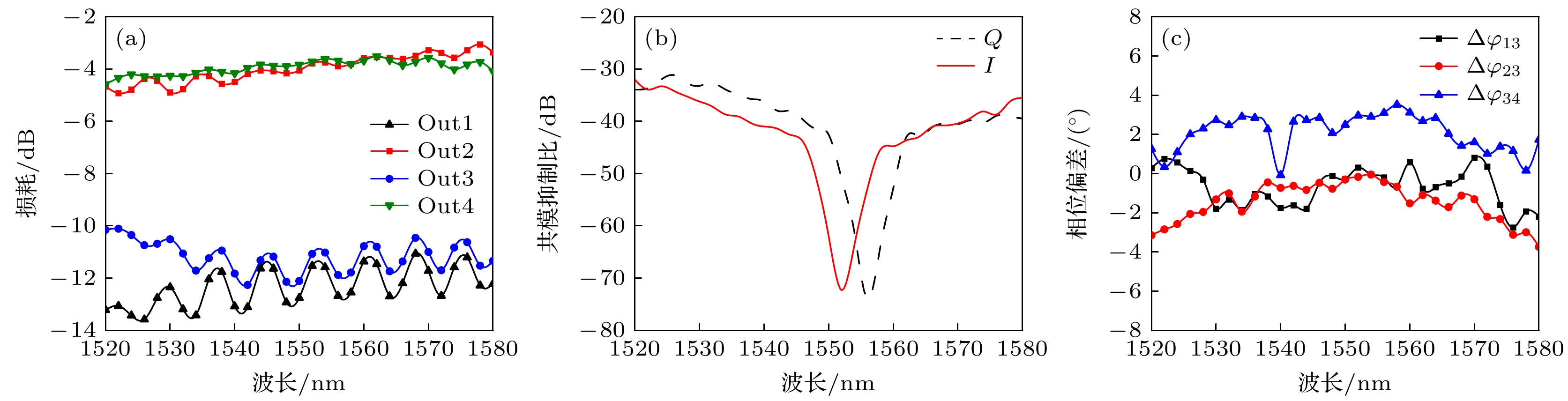
图 8 性能指标随波长变化情况 (a) 90°光混频器损耗随波长变化曲线; (b) 90°光混频器共模抑制比随波长变化曲线; (c) 不同输出端口之间的相位偏差随波长变化曲线
Figure 8. Variation of performance index with wavelength: (a) Variation curves of loss of 90° optical mixer with wavelength; (b) variation curves of common mode rejection ratio of 90° optical mixer with wavelength; (c) variation curves of phase deviation between different output ports with wavelength.
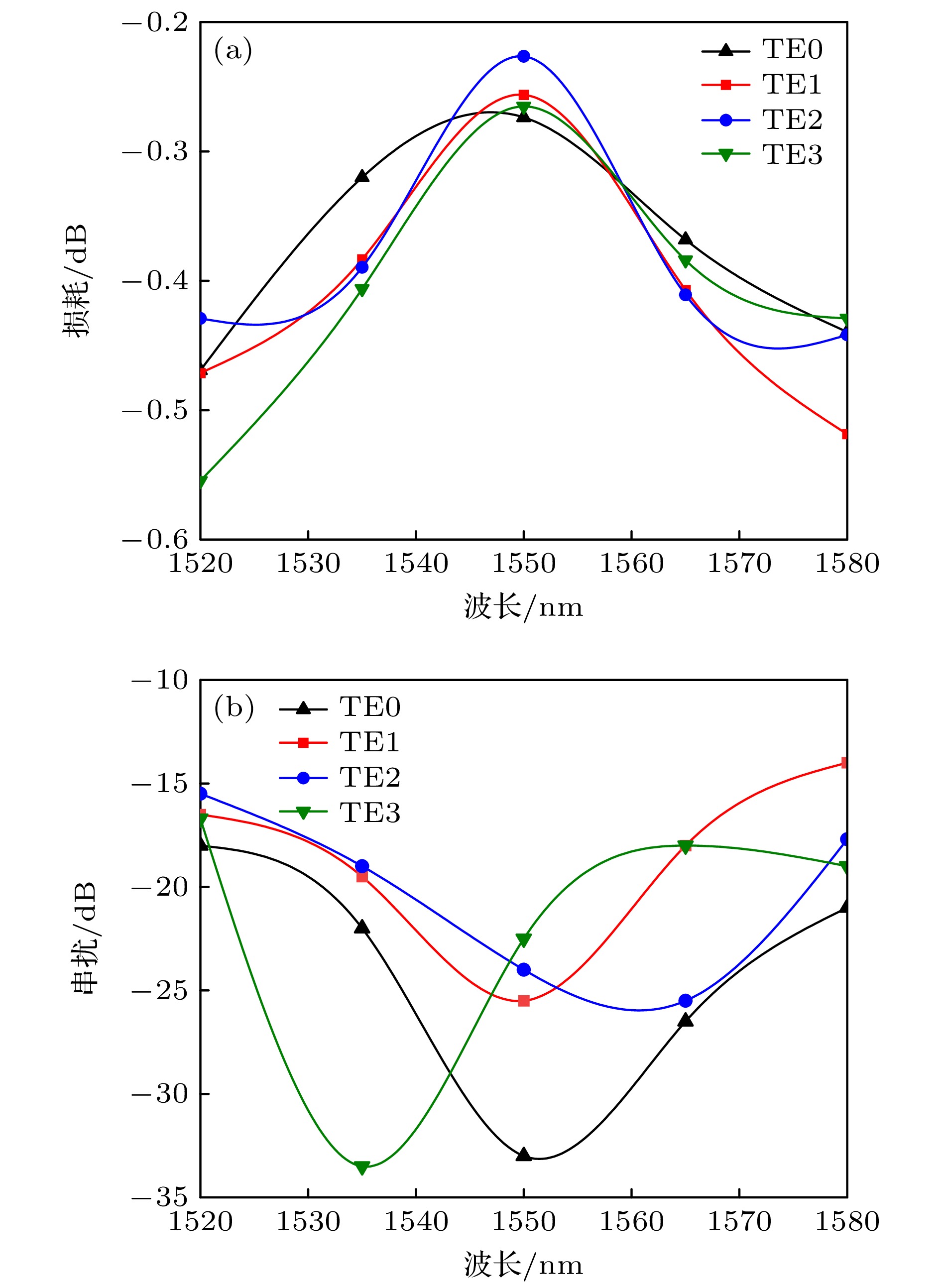
图 9 模式分离器性能指标 (a) 模式分离器损耗; (b) 模式分离器串扰
Figure 9. Performance index of mode separator: (a) Mode separator loss; (b) mode separator crosstalk.
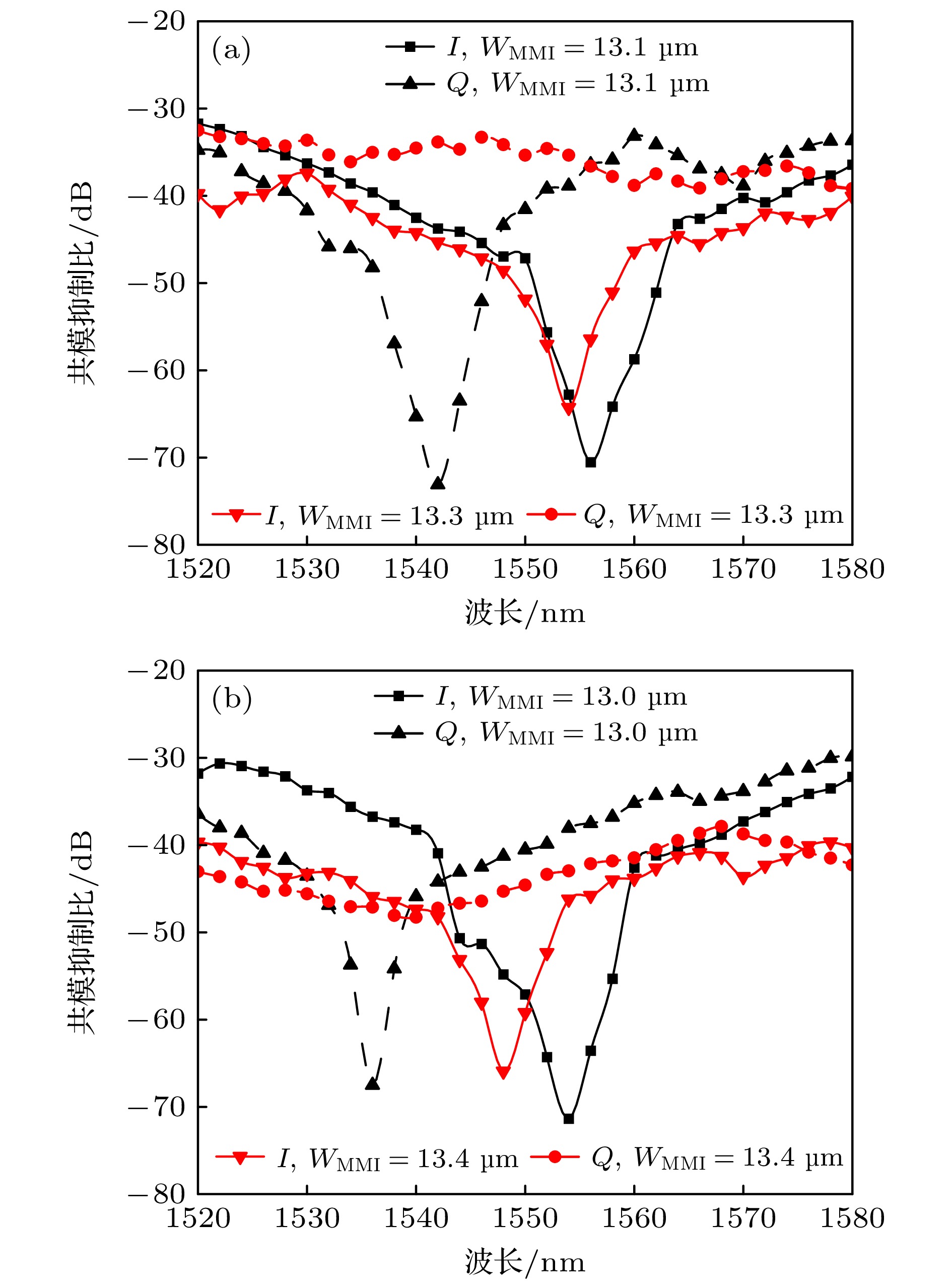
图 10 宽度容差下共模抑制比性能分析 (a) MMI宽度容差范围为±0.1 μm; (b) MMI宽度容差范围为±0.2 μm
Figure 10. Performance analysis of common mode rejection ratio under width tolerance: (a) The tolerance range of MMI width is ±0.1 μm; (b) the width of MMI tolerance range is ±0.2 μm.
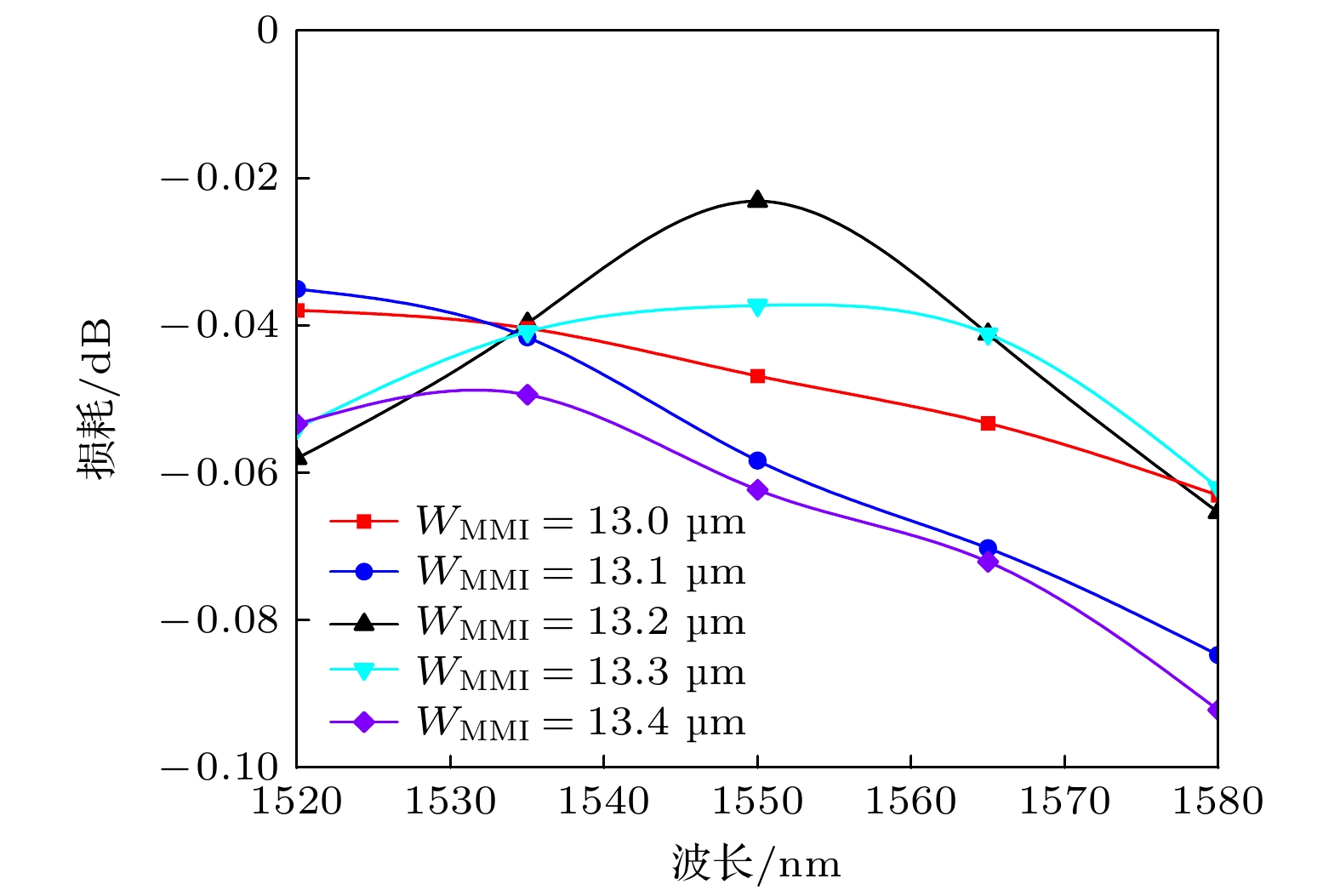
图 11 宽度容差下损耗性能分析
Figure 11. Analysis of loss performance under width tolerance.

图 12 宽度容差下相位偏差性能分析 (a) MMI宽度为13 μm; (b) MMI宽度为13.1 μm; (c) MMI宽度为13.3 μm; (d) MMI宽度为13.4 μm
Figure 12. Performance analysis of phase deviation under width tolerance: (a) The MMI width is 13 μm; (b) the MMI width is 13.1 μm; (c) the MMI width is 13.3 μm; (d) the MMI width is 13.4 μm.
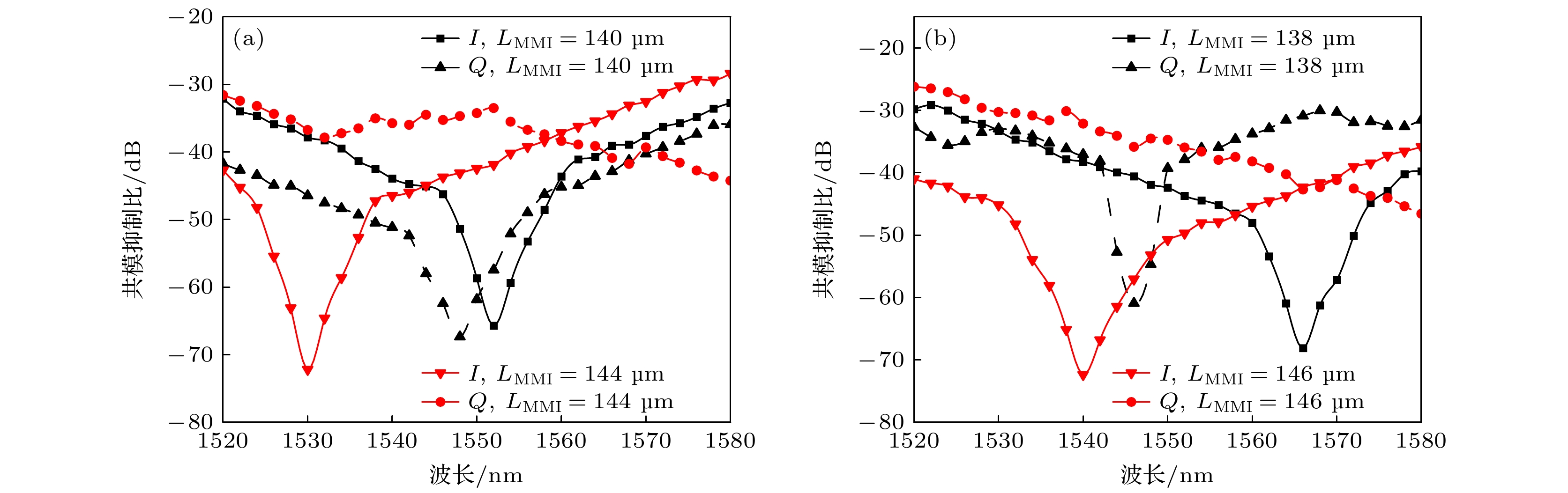
图 13 长度容差下共模抑制比性能分析 (a) MMI长度容差范围为±2 μm; (b) MMI长度容差范围为±4 μm
Figure 13. Performance analysis of common mode rejection ratio under length tolerance: (a) The tolerance range of MMI length is ±2 μm; (b) the tolerance range of MMI length is ±4 μm.
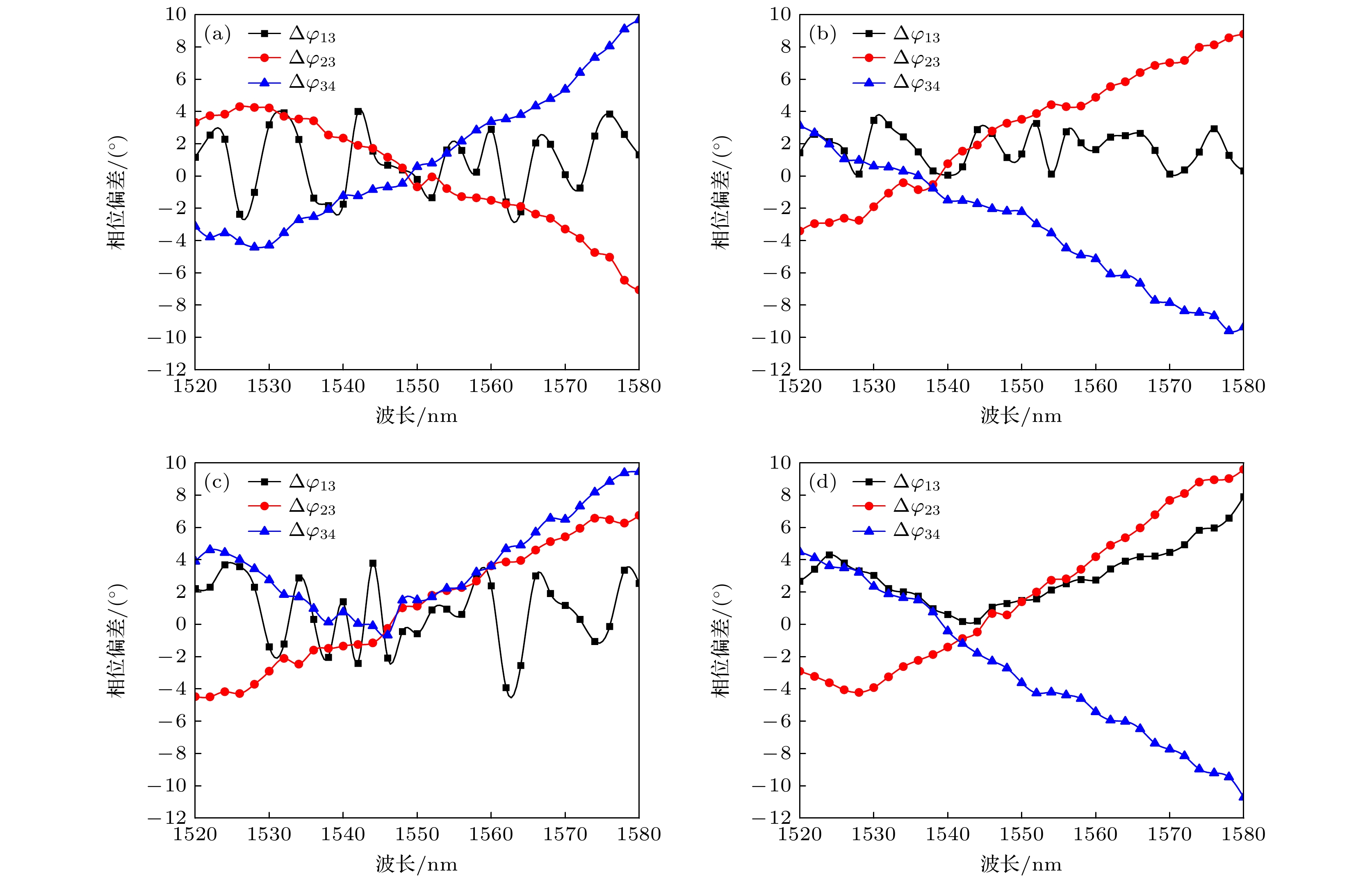
图 14 长度容差下相位偏差性能分析 (a) MMI长度为138 μm; (b) MMI长度为140 μm; (c) MMI长度为144 μm; (d) MMI长度为148 μm
Figure 14. Performance analysis of phase deviation under length tolerance: (a) The MMI length is 138 μm; (b) the MMI length is 140 μm; (c) the MMI length is 144 μm; (d) the MMI length is 148 μm.
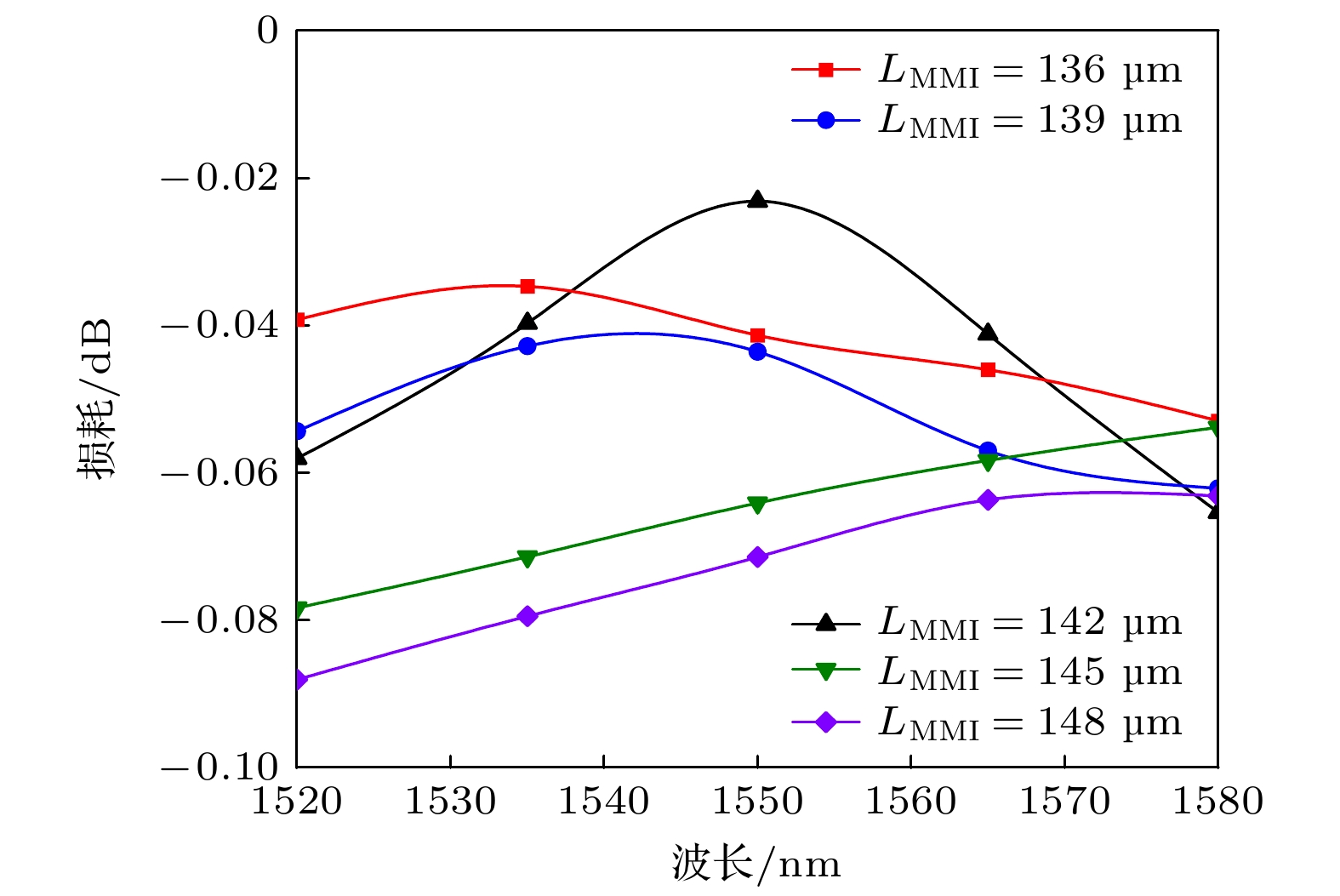
图 15 长度容差下损耗性能分析
Figure 15. Analysis of loss performance under length tolerance.
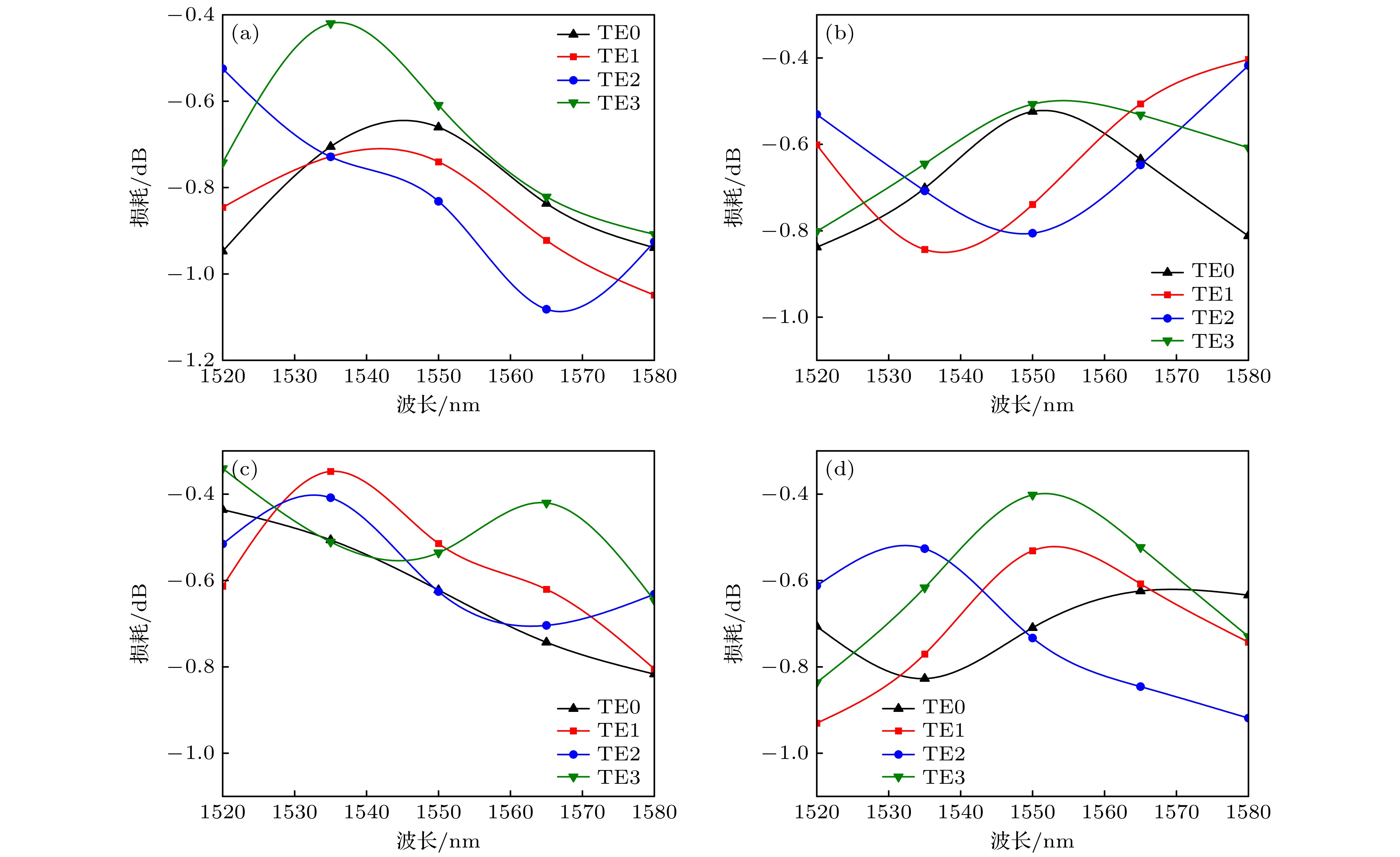
图 16 宽度容差下损耗性能分析 (a) MMI宽度为13 μm; (b) MMI宽度为13.1 μm; (c) MMI宽度为13.3 μm; (d) MMI宽度为13.4 μm
Figure 16. Analysis of loss performance under width tolerance: (a) The MMI width is 13 μm; (b) the MMI width is 13.1 μm; (c) the MMI width is 13.3 μm; (d) the MMI width is 13.4 μm.
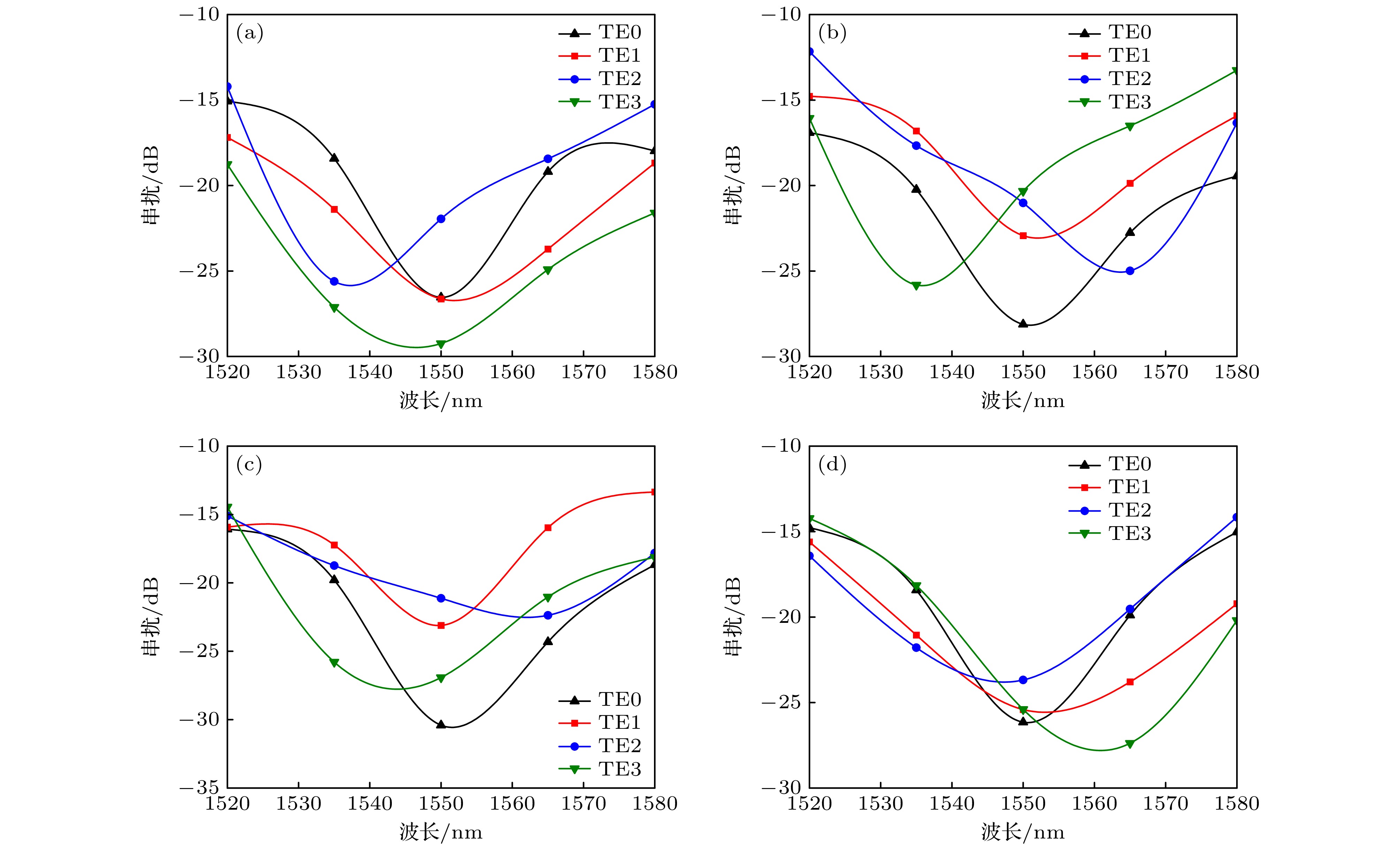
图 17 宽度容差下串扰性能分析 (a) MMI宽度为13 μm; (b) MMI宽度为13.1 μm; (c) MMI宽度为13.3 μm; (d) MMI宽度为13.4 μm
Figure 17. Analysis of crosstalk performance under width tolerance: (a) The MMI width is 13 μm; (b) the MMI width is 13.1 μm; (c) the MMI width is 13.3 μm; (d) the MMI width is 13.4 μm.
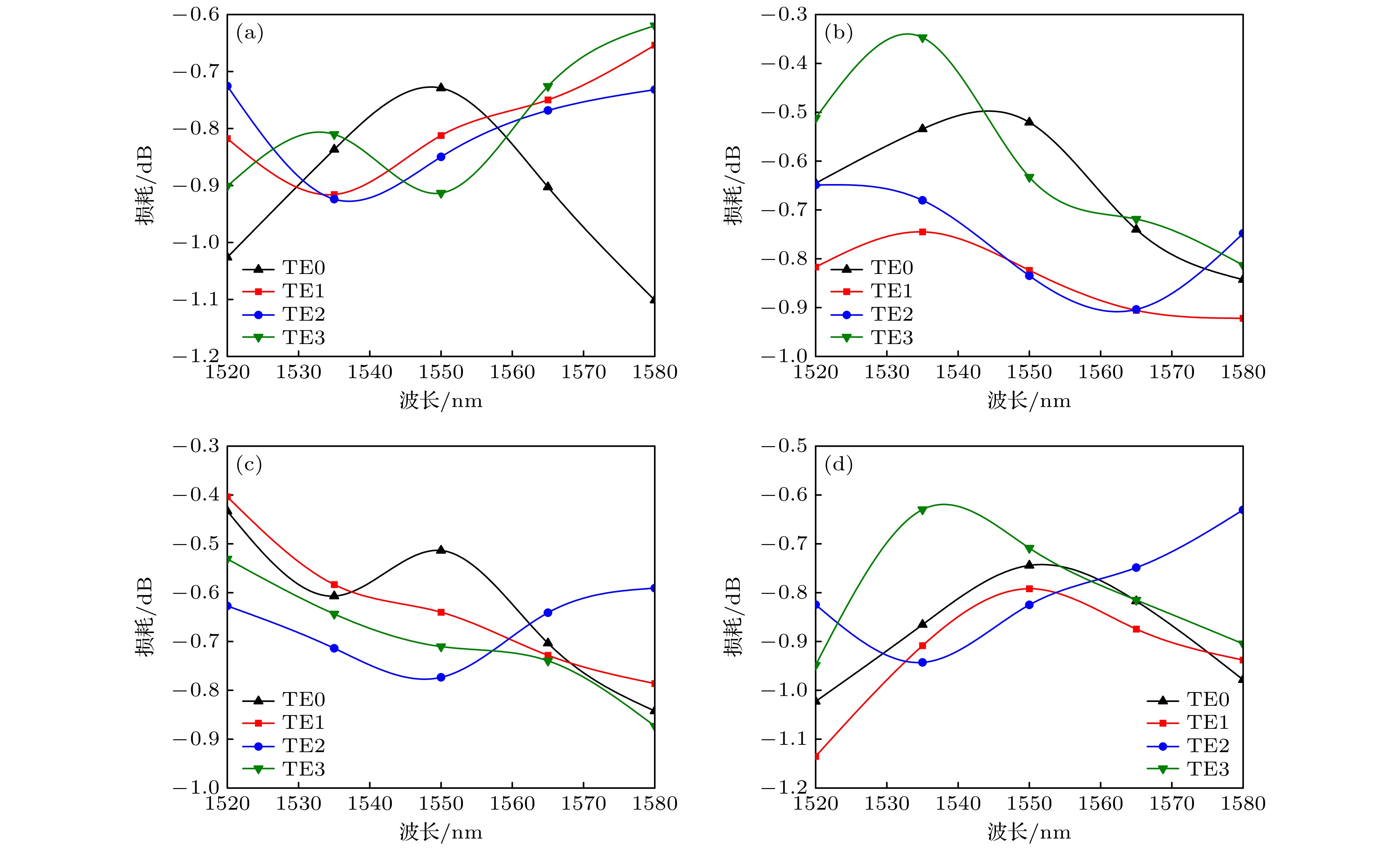
图 18 长度容差下损耗性能分析 (a) MMI长度为138 μm; (b) MMI长度为140 μm; (c) MMI长度为144 μm; (d) MMI长度为148 μm
Figure 18. Analysis of loss performance under length tolerance: (a) The MMI length is 138 μm; (b) the MMI length is 140 μm; (c) the MMI length is 144 μm; (d) the MMI length is 148 μm.
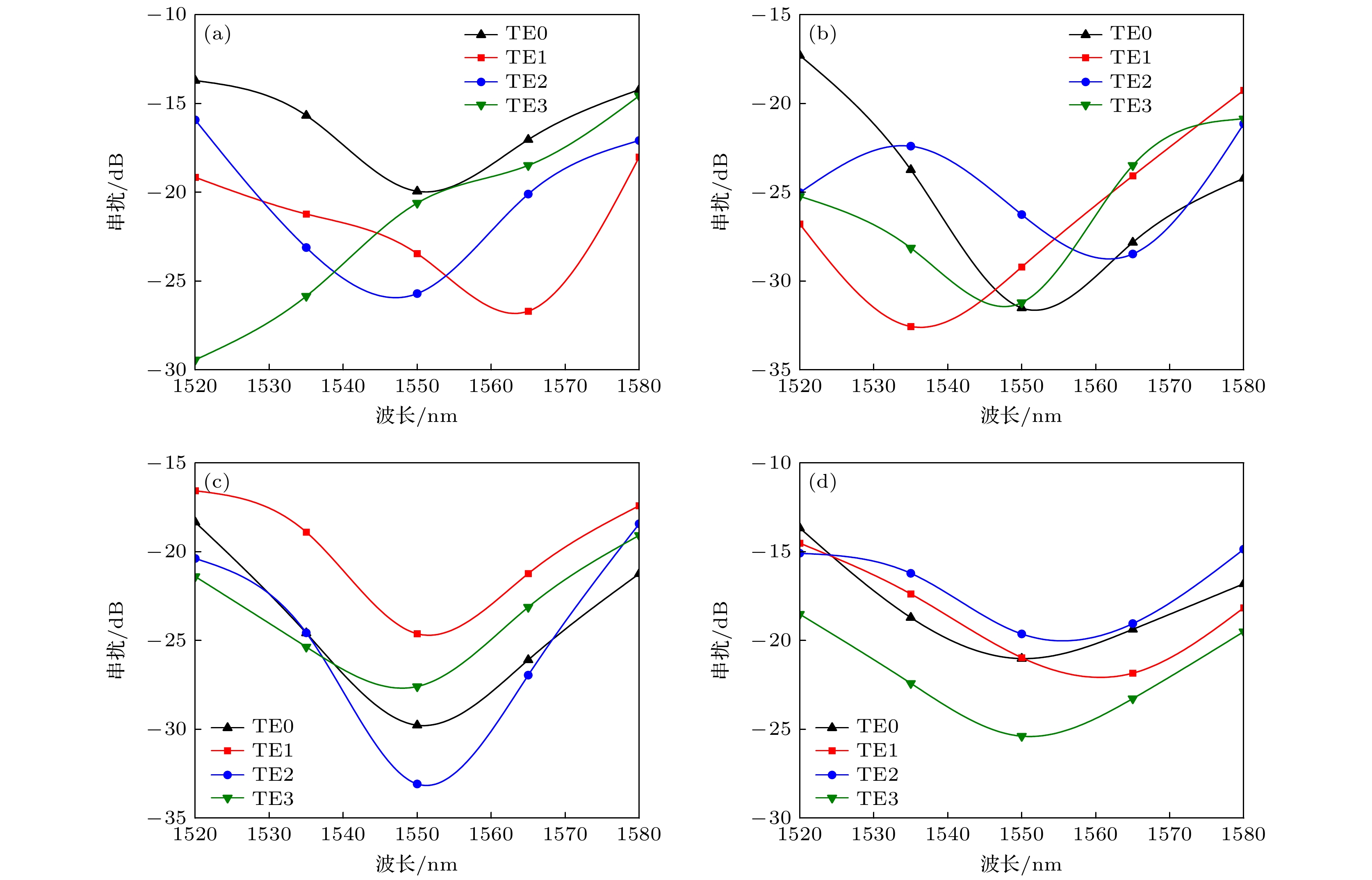
图 19 长度容差下串扰性能分析 (a) MMI长度为138 μm; (b) MMI长度为140 μm; (c) MMI长度为144 μm; (d) MMI长度为148 μm
Figure 19. Analysis of crosstalk performance under length tolerance: (a) The MMI length is 138 μm; (b) the MMI length is 140 μm; (c) the MMI length is 144 μm; (d) the MMI length is 148 μm.
-
[1] 韩笑天, 聂文超, 李鹏, 李广英, 常畅, 张鹏飞, 廖佩璇, 谢琛华, 李慧, 汪伟, 谢小平 2025 光学学报 45 1306016
Google Scholar
Han X T, Nie W C, Li P, Li G Y, Chang C, Zhang P F, Liao P X, Xie C H, Li H, Wang W, Xie X P 2025 Acta Opt. Sin. 45 1306016
Google Scholar
[2] Xing J J, Li Z Y, Xiao X, Yu J Z, Yu Y D 2013 Opt. Lett. 38 3468
Google Scholar
[3] 马天宝, 祁玲珍, 彭姝, 李佳明, 郭旭联, 刘奎 2024 光学学报 44 1627001
Google Scholar
Ma T B, Qi L Z, Peng S, Li J M, Guo X L, Liu K 2024 Acta Opt. Sin. 44 1627001
Google Scholar
[4] Driscoll J B, Grote R R, Souhan B, Dadap J I, Lu M, Osgood R M 2013 Opt. Lett. 38 1854
Google Scholar
[5] Halir R, Molina-Fernández I, Ortega-Moñux A, Wangüemert-Pérez J G, Xu D X, Cheben P, Janz S 2008 J. Lightwave Technol. 26 2697
Google Scholar
[6] Jeong S H, Morito K 2010 J. Lightwave Technol. 28 1323
Google Scholar
[7] Voigt K, Zimmermann L, Winzer G, Tian H, Tillack B, Petermann K 2011 IEEE Photonics Technol. Lett. 23 1769
Google Scholar
[8] Halir R, Roelkens G, Ortega-Moñux A, Wangüemert-Pérez J G 2011 Opt. Lett. 36 178
Google Scholar
[9] Yang W, Yin M, Li Y P, Wang X J, Wang Z Y 2013 Opt. Express 21 28423
Google Scholar
[10] Liao J W, Zhang L X, Liu M L, Wang L R, Wang W Q, Wang G X, Ruan C, Zhao W, Zhang W F 2016 IEEE Photonics Technol. Lett. 28 2597
Google Scholar
[11] Jiang W F, Wang X G 2020 J. Lightwave Technol. 38 2414
Google Scholar
[12] Liu D J, Zhang M, Shi Y C, Dai D X 2020 IEEE Photonics Technol. Lett. 32 192
Google Scholar
[13] Jiang W F, Xu S Y 2021 J. Lightwave Technol. 39 6239
Google Scholar
[14] Chen T, Dang Z Q, Liu Z X, Ding Z M, Yang Z F, Zhang X D, Jiang X H, Zhang Z Y 2021 IEEE Photonics Technol. Lett. 33 1135
Google Scholar
[15] 陈涛, 毛思强, 万洪丹, 汪静丽, 蒋卫锋 2023 光学学报 43 2313003
Google Scholar
Chen T, Mao S Q, Wan H D, Wang J L, Jiang W F 2023 Acta Opt. Sin. 43 2313003
Google Scholar
[16] 廖莎莎, 张伍浩, 赵帅, 赵薪程, 唐亮 2024 光学学报 44 0523001
Google Scholar
Liao S S, Zhang W H, Zhao S, Zhao X C, Tang L 2024 Acta Opt. Sin. 44 0523001
Google Scholar
[17] 王曼卓, 姚振涛, 孙朝阳, 张越, 方记民, 孙小强, 吴远大, 张大明 2025 光子学报 54 0323001
Google Scholar
Wang M Z, Yao Z T, Sun C Y, Zhang Y, Fang J M, Sun X Q, Wu Y D, Zhang D M 2025 Acta Photonica Sin. 54 0323001
Google Scholar
[18] Qi Y, Li Y 2020 Nanophotonics 9 1287
Google Scholar
[19] 徐光耀, 马晓飞, 盛冲, 刘辉 2023 光学学报 43 1923001
Google Scholar
Xu G Y, Ma X F, Chong S, Liu H 2023 Acta Opt. Sin. 43 1923001
Google Scholar
[20] 冯新凯, 陈怀熹, 陈家颖, 梁万国 2023 中国激光 50 2208001
Google Scholar
Feng X K, Chen H X, Chen J Y, Liang W G 2023 Chin. J. Lasers 50 2208001
Google Scholar
[21] Guan H, Ma Y J, Shi R Z, Zhu X L, Younce R, Chen Y J, Roman J, Ophir N, Liu Y, Ding R, Baehr-Jones T, Bergman K, Hochberg M 2017 Opt. Express 25 28957
Google Scholar
[22] Ortega-Monux A, Zavargo-Peche L, Maese-Novo A, Molina-Fernandez I, Halir R, Wanguemert-Perez J G, Cheben P, Schmid J H 2011 IEEE Photonics Technol. Lett. 23 1406
Google Scholar

 DownLoad:
Catalog
Metrics
- Abstract views: 386
- PDF Downloads: 4
- Cited By: 0
