














-
A large number of energetic particles (EPs) are generated in the heating process to obtain the high temperature plasma for fusion research. These EPs can resonantly excite various magnetohydrodynamic (MHD) instabilities, including the Alfvén eigenmodes (AEs) and the energetic particle modes (EPMs). The excitation of such MHD instabilities can lead to significant EP losses, which not only degrades the plasma confinement and heating efficiency, but also results in excessive heat loads and damage to plasma-facing components. In this work, the influences of key plasma parameters on the excitation and damping effect of EP-driven MHD instabilities in Heliotron J device are investigated for better understanding of the excitation and transport mechanism of EPs driven MHD in specific device, which is meaningful for achieving stable plasma operation in future fusion devices with different heating methods. In this work, the typical EPs driven MHD instabilities are observed using various diagnostic methods, such as magnetic probes, beam emission spectroscopy (BES), electron cyclotron resonance (ECE) radiometers, and interferometers. Combined with the simulation results from STELLGAP and FAR3D programs, the modulus, radial distribution, and spectral characteristics of different instabilities are analyzed in depth, revealing the evolutions of AEs and EPMs in the Heliotron J device under typical heating conditions. This study quantitatively reveals the driving and suppressing mechanisms of EP-driven instabilities by the electron density (ne), the electron temperature (Te), and the energetic/thermal particle specific pressure (βf/βth) in Heliotron J device, under the conditions of different electron cyclotron resonance heating (ECH) and neutral beam injection (NBI). The results show that different characteristics are obtained under the different magnetic field geometry conditions. The results show that an increase in electron density can reduce the instability intensity by about 40%–60%, and an increase in the specific pressure of energetic particles can double the modal growth rate, while an increase in the specific pressure of hot particles has an inhibitory effect of 20%–50% on the growth rate of the low order modes. These findings are useful for understanding the different effects of ECH and NBI on the EPs driven MHD instabilities, and they are also helpful for achieving stable operation by adjusting the heating system parameters in the stellarator-like devices in the future.

[1] 孙有文, 仇志勇, 万宝年 2024 物理学报 73 175202
 Google Scholar
Sun Y W, Qiu Z Y, Wan B N 2024 Acta Phys. Sin. 73 175202
Google Scholar
[2] 黄捷, 李沫杉, 覃程, 王先驱 2022 物理学报 71 185202
Google Scholar
Huang J, Li M S, Qin C, Wang X Q 2022 Acta Phys. Sin. 71 185202
Google Scholar
[3] 苏祥, 王先驱, 符添, 许宇鸿 2023 物理学报 72 215205
Google Scholar
Su X, Wang X Q, Fu T, Xu Y H 2023 Acta Phys. Sin. 72 215205
Google Scholar
[4] 罗耀全, 王龙, 杨思泽, 陈雁萍, 戚霞枝, 李赞良, 王文书, 李文莱, 赵华, 唐继辉, 谭富传 1990 物理学报 39 399
Google Scholar
Luo Y Q, Wang L, Yang S Z, Chen Y P, Qi X Z, Li Z L, Wang W S, Li W L, Zhao H, Tang J H, Tan F C 1990 Acta Phys. Sin. 39 399
Google Scholar
[5] 石秉仁 1999 磁约束聚变原理与实践(北京: 原子能出版社) 第192—197页
Shi B R 1999 Principles and Practice of Magnetic Confinement Fusion (Beijing: Atomic Energy Press) pp192–197
[6] 张伟, 张新军, 刘鲁南, 朱光辉, 杨桦, 张华朋, 郑艺峰, 何开洋, 黄娟 2023 物理学报 72 215201
Google Scholar
Zhang W, Zhang X J, Liu L N, Zhu G H, Yang H, Zhang H P, Zheng Y F, He K Y, Huang J 2023 Acta Phys. Sin. 72 215201
Google Scholar
[7] Toi K, Ogawa K, Isobe M, Osakabe M, Spong D A 2011 Plasma Phys. Contr. Fusion 53 024008
Google Scholar
[8] Breizman B N, Sharapov S E 2011 Plasma Phys. Contr. Fusion 53 054001
Google Scholar
[9] Yamamoto S, Nagasaki K, Kobayashi S, Nagaoka K, Cappa A, Okada H, Minami T, Kado S, Ohshima S, Konoshima S, Nakamura Y, Ishizawa A, Weir G M, Kenmochi N, Ohtani Y, Lu X, Tawada Y, Kokubu D, Mizuuchi T 2017 Nucl. Fusion 57 126065
Google Scholar
[10] Yamamoto S, Nagasaki K, Nagaoka K , Watanabe K Y, Spong D A, Garcia L, Cappa A 2020 Nucl. Fusion 60 066018
Google Scholar
[11] Nagaoka K, Ido T, Ascasibar E, Estrada T, Yamamoto S, Melnikov A V, Cappa A, Hidalgo C, Pedrosa M A, van Milligen B P, Pastor I, Liniers M, Ochando M A, Shimizu A, Eliseev L G, Ohshima S, Mukai K, Takeiri Y 2013 Nucl. Fusion 53 072004
Google Scholar
[12] Spong D A, Sanchez R, Weller A 2003 Phys. Plasmas 10 3217
Google Scholar
[13] Jiang X H, Li S, Liu Y, Wang S, Jia F, Wang T, Han L, Zhang X 2024 Proceedings of the AAAI Conference on Artificial Intelligence Vancouver, BC, February 22–25, 2024 p2561
[14] Charlton L A, Holmes J A, Hicks H R, Lynch V E, Carreras B A 1986 J. Comput. Phys. 63 107
Google Scholar
[15] Spong D A 2013 Nucl. Fusion 53 053008
Google Scholar
[16] Varela J, Spong D A, García L, Todo, Huang J, Murakami M 2019 Phys. Plasmas 26 062502
Google Scholar
[17] Varela J, Spong D, Garcia L, Ghai Y, Ortiz J 2024 Front. Phys. 12 1422411
Google Scholar
[18] Weller A, Spong D A, Jaenicke R, Lazaros A, Penningsfeld F P, Sattler S 1994 Phys. Rev. Lett. 72 1220
Google Scholar
[19] Eliseev L G, Melnikov A V, Ascasíbar E, Cappa A, Drabinskiy M, Hidalgo C, Khabanov P O, Kharchev N K, Kozachek A S, Liniers M, Lysenko S E, Ochando M de Pablos J L, Pastor I, Sharapov S E, Spong D A, Breizman B N, Varela J 2021 Phys. Plasmas 28 072510
Google Scholar
[20] Mizuuchi T, Nakasuga M, Sano F, Nakamura Y, Kondo K, Okada H, Nagasaki K, Besshou S, Wakatani M, Obiki T 1999 Proceedings of the 12th International Stellarator Workshop Madison, USA, September 6–10, 1999 p192
[21] Obiki T, Mizuuchi T, Nagasaki K, Okada H, Besshou S, Sano F, Hanatani K, Liu Y, Hamada T, Manabe Y, Shidara H, Ang W, Liu Y, Ikeda Y, Kawazome Y, Kobayashi T, Takamiya T, Takeda M, Ijiri Y, Senju T, Yaguchi K, Sakamoto K, Toshi K 2001 Nucl. Fusion 41 833
Google Scholar
[22] Kobayashi S, Nagaoka K, Yamamoto S, Mizuuchi T, Nagasaki K, Okada H, Minami T, Murakami S, Lee H, Suzuki Y, Nakamura Y, Takeiri Y, Yokoyama M, Hanatani K, Hosaka K, Konoshima S, Ohshima S, Toushi K, Sano F 2010 Contrib. Plasm. Phys. 50 534
Google Scholar
[23] Zhong Y, Nagasaki K, Wang Z, Kobayashi S, Inagaki S, Minami T, Kado S, Ohshima S, Kin F, Wang C, Nakamura Y, Konoshima S, Mizuuchi T, Okada H, Marushchenko N, Chen J 2024 Plasm. Fusion Res. 19 1202008
Google Scholar
[24] Nagasaki K, Yamamoto S, Kobayashi S, Sakamoto K, Nagae Y, Sugimoto Y, Nakamura Y, Weir G M, Marushchenko N, Mizuuchi T, Okada H, Minami T, Masuda K, Ohshima S, Konoshima S, Shi N, Nakamura Y, Lee H Y, Zang L, Arai S, Watada H, Fukushima H, Hashimoto K, Kenmochi N, Motojima G, Yoshimura Y, Mukai K, Volpe F, Estrada T, Sano F 2013 Nucl. Fusion 53 113041
Google Scholar
[25] Heidbrink W W 2008 Phys. Plasmas 15 055501
Google Scholar
-
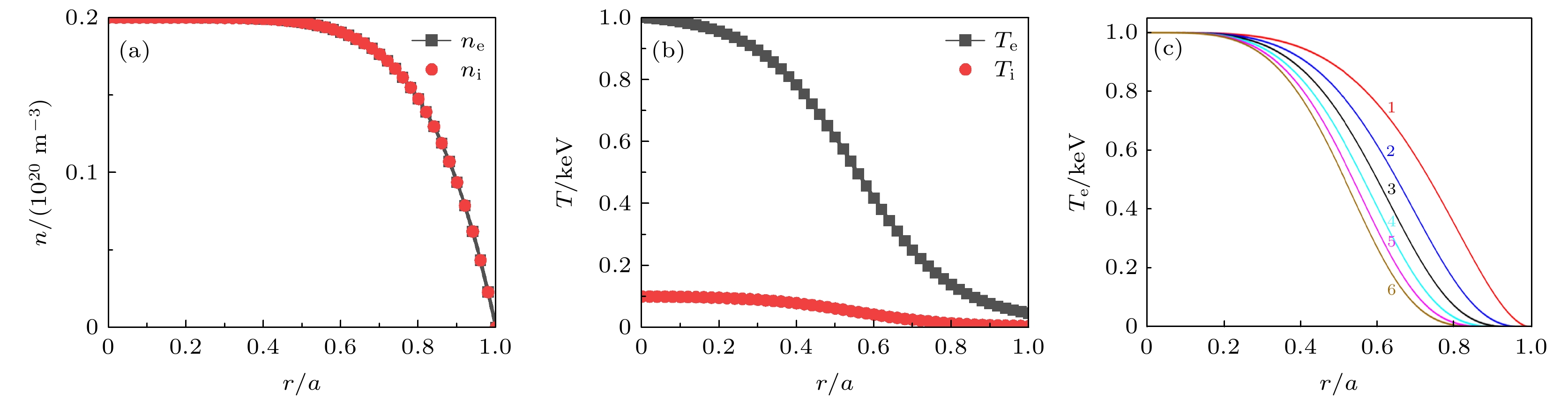
图 1 FAR3D程序中的平衡参数设置 (a)等离子体密度; (b)等离子体温度; (c)电子温度剖面
Figure 1. Parameter settings in the FAR3D code: (a) Plasma density; (b) plasma temperature; (c) electron temperature profile.

图 2 STELLGAP代码中等离子体电流剖面参数设计
Figure 2. Plasma current profile parameter design in STELLGAP code.


图 4 (a) 主导模态n/m = 2/4和n/m = 2/3的本征函数幅值空间分布计算结果; (b) 实验中模态相对强度与径向归一化坐标的关系
Figure 4. (a) Eigenfunction of the dominant mode of n/m = 2/4 and n/m = 2/3 mode; (b) radial profiles of mode relative intensities from experiments.
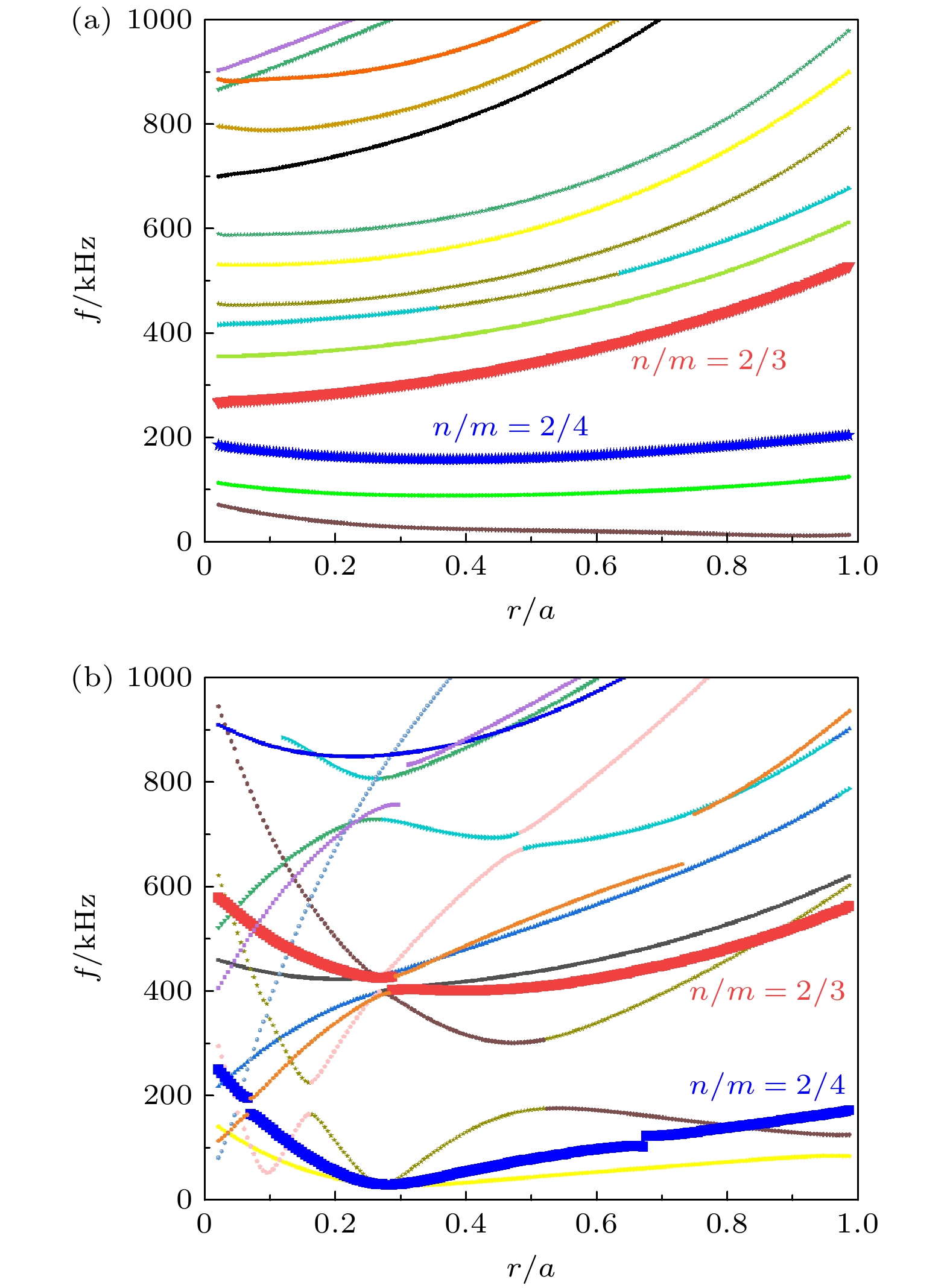
图 5 在Heliotron J装置中剪切阿尔芬连续谱在Ip = 0 (a)和Ip = 2.0 kA (b)下的MHD平衡状态下的表现
Figure 5. Shear Alfvén continuum structure in MHD equilibrium at Ip = 0 (a) and Ip = 2.0 kA (b) in Heliotron J.
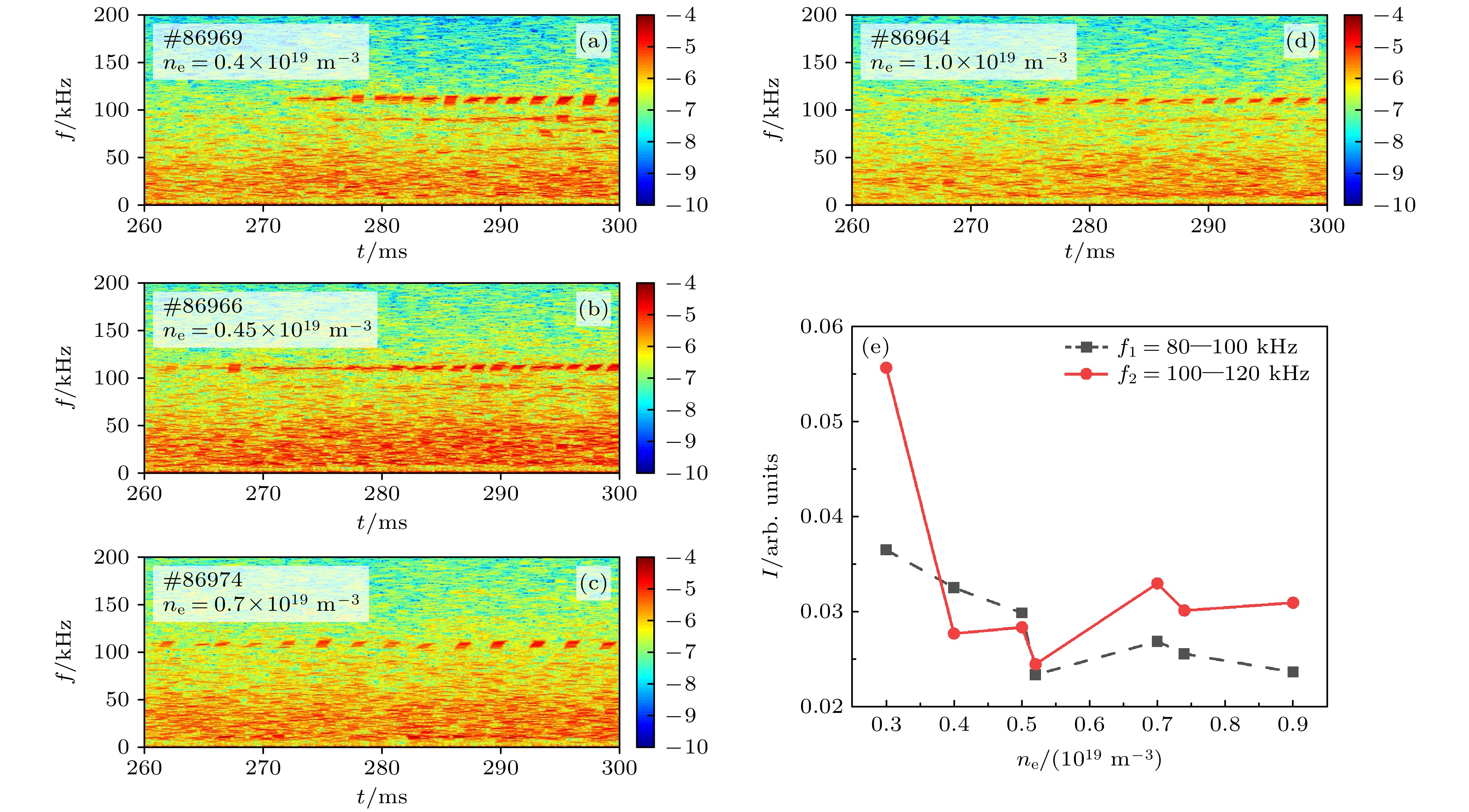
图 6 在高ECH条件下, 不同电子密度下功率谱密度的时间演化(a)—(d)及不稳定性强度随电子密度的变化(e)
Figure 6. Time evolution of the power spectral density at different electron densities (a)–(d) and the variation of instability intensity with electron density (e) at high ECH situation.
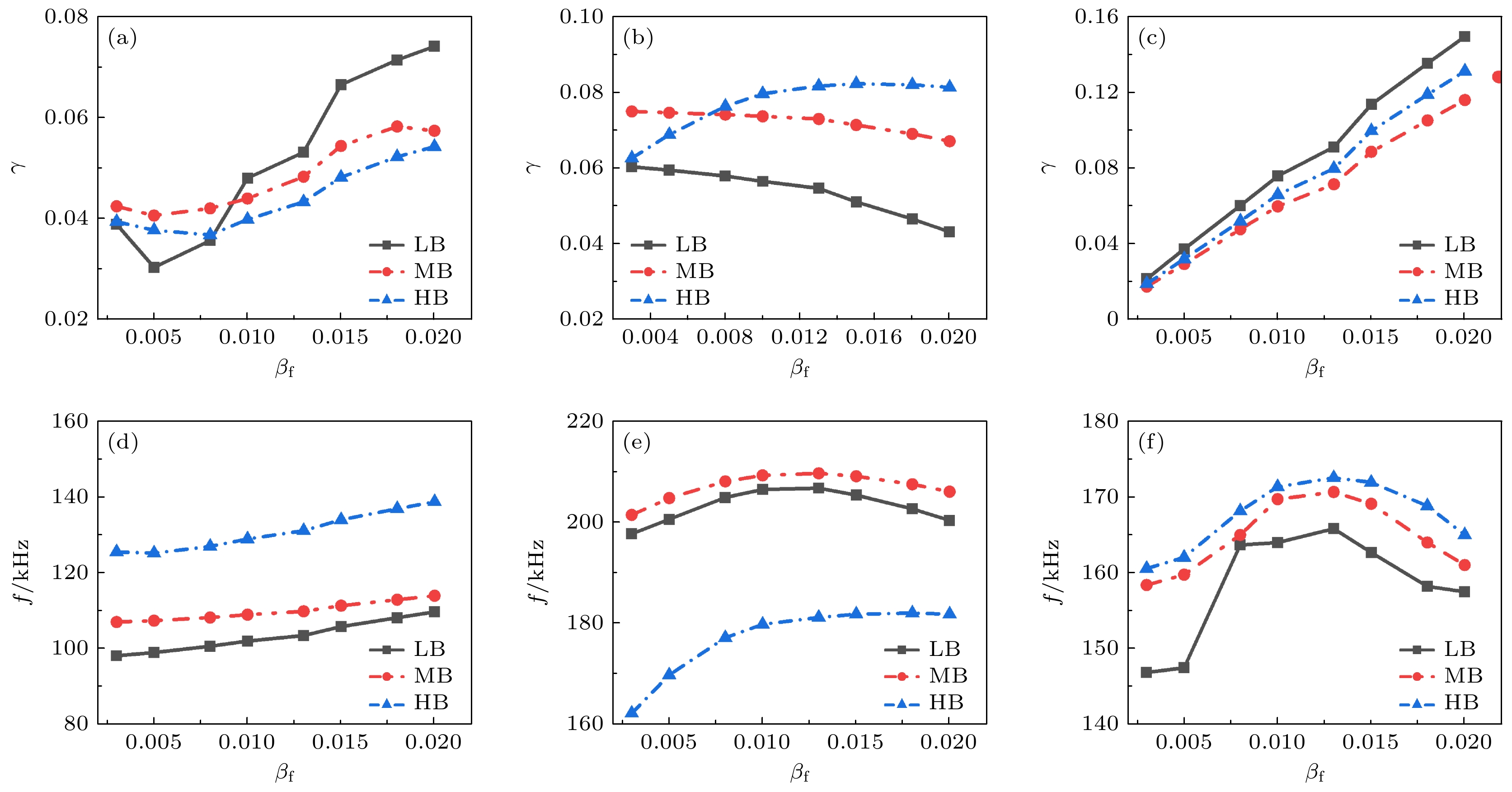
图 7 在3种磁场位型下, 随着快粒子比压(βf)的变化 (a), (d) n/m = 1/2模的增长率和频率; (b), (e) n/m = 2/3模的增长率和频率; (c), (f) n/m = 2/4模的增长率和频率
Figure 7. Under three magnetic field configurations, with the change of the fast particle beta (βf): (a), (d) Growth rate and the frequency of the n/m = 1/2; (b), (e) growth rate and the frequency of the n/m = 2/3; (c), (f) growth rate and the frequency of the n/m = 2/4 mode.
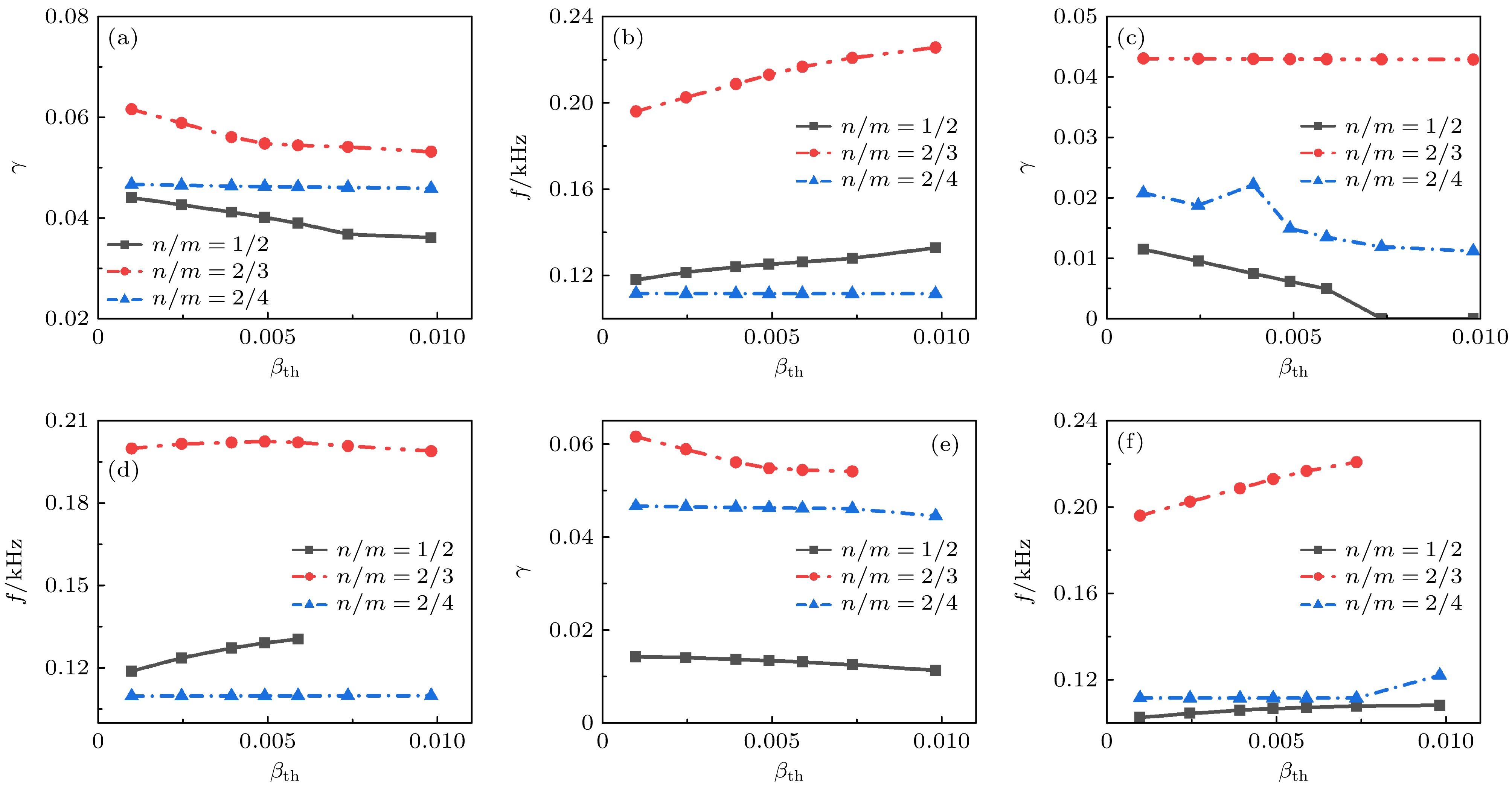
图 8 n/m = 1/2, 2/3, 2/4模在3种磁场构型下, 随着热粒子比压(βth)增大的增长率与频率的变化情况 (a), (d) LB; (b), (e) MB; (c), (f) HB
Figure 8. Growth rate (γ) and the frequency (f) of the n/m = 1/2, 2/3, and 2/4 mode in the three configurations with the change of thermal particle beta (βth): (a), (d) LB; (b), (e) MB; (c), (f) HB
内容 FAR3D STELLGAP 目标 模拟模式的时域演化、增长率、结构,
适用于AE、不稳定性分析等分析阿尔芬连续谱结构, 识别频率gap,
判断是否支持共振模式(如TAE)目标输入要求 VMEC平衡态+粒子参数等 仅需VMEC平衡态 物理机制 包括电阻、Landau阻尼、Geodesic acoustic waves、波-粒共振等 不含耗散机制, 仅考虑MHD连续谱结构  DownLoad: CSV
表 2 加热过程影响的关键等离子体参数表
Table 2. Critical plasma parameters modified during heating.
等离子体参数 直接影响的物理量 作用效果 电子密度 热比压(βth),
等离子体压强(P)电子密度升高会通过降低快粒子相对压强(βf/βth)、增强碰撞与Landau阻尼、改变
阿尔芬速度与共振条件等间接途径增强阻尼, 有助于抑制高能粒子驱动的不稳定性电子温度 粒子慢化时间(τ),
快粒子比压(βf)双重作用: 降低βf有助于抑制模态激发(增加稳定性),
削弱阻尼可能提升模态增长率(降低稳定性)
DownLoad: CSV
-
[1] 孙有文, 仇志勇, 万宝年 2024 物理学报 73 175202
Google Scholar
Sun Y W, Qiu Z Y, Wan B N 2024 Acta Phys. Sin. 73 175202
Google Scholar
[2] 黄捷, 李沫杉, 覃程, 王先驱 2022 物理学报 71 185202
Google Scholar
Huang J, Li M S, Qin C, Wang X Q 2022 Acta Phys. Sin. 71 185202
Google Scholar
[3] 苏祥, 王先驱, 符添, 许宇鸿 2023 物理学报 72 215205
Google Scholar
Su X, Wang X Q, Fu T, Xu Y H 2023 Acta Phys. Sin. 72 215205
Google Scholar
[4] 罗耀全, 王龙, 杨思泽, 陈雁萍, 戚霞枝, 李赞良, 王文书, 李文莱, 赵华, 唐继辉, 谭富传 1990 物理学报 39 399
Google Scholar
Luo Y Q, Wang L, Yang S Z, Chen Y P, Qi X Z, Li Z L, Wang W S, Li W L, Zhao H, Tang J H, Tan F C 1990 Acta Phys. Sin. 39 399
Google Scholar
[5] 石秉仁 1999 磁约束聚变原理与实践(北京: 原子能出版社) 第192—197页
Shi B R 1999 Principles and Practice of Magnetic Confinement Fusion (Beijing: Atomic Energy Press) pp192–197
[6] 张伟, 张新军, 刘鲁南, 朱光辉, 杨桦, 张华朋, 郑艺峰, 何开洋, 黄娟 2023 物理学报 72 215201
Google Scholar
Zhang W, Zhang X J, Liu L N, Zhu G H, Yang H, Zhang H P, Zheng Y F, He K Y, Huang J 2023 Acta Phys. Sin. 72 215201
Google Scholar
[7] Toi K, Ogawa K, Isobe M, Osakabe M, Spong D A 2011 Plasma Phys. Contr. Fusion 53 024008
Google Scholar
[8] Breizman B N, Sharapov S E 2011 Plasma Phys. Contr. Fusion 53 054001
Google Scholar
[9] Yamamoto S, Nagasaki K, Kobayashi S, Nagaoka K, Cappa A, Okada H, Minami T, Kado S, Ohshima S, Konoshima S, Nakamura Y, Ishizawa A, Weir G M, Kenmochi N, Ohtani Y, Lu X, Tawada Y, Kokubu D, Mizuuchi T 2017 Nucl. Fusion 57 126065
Google Scholar
[10] Yamamoto S, Nagasaki K, Nagaoka K , Watanabe K Y, Spong D A, Garcia L, Cappa A 2020 Nucl. Fusion 60 066018
Google Scholar
[11] Nagaoka K, Ido T, Ascasibar E, Estrada T, Yamamoto S, Melnikov A V, Cappa A, Hidalgo C, Pedrosa M A, van Milligen B P, Pastor I, Liniers M, Ochando M A, Shimizu A, Eliseev L G, Ohshima S, Mukai K, Takeiri Y 2013 Nucl. Fusion 53 072004
Google Scholar
[12] Spong D A, Sanchez R, Weller A 2003 Phys. Plasmas 10 3217
Google Scholar
[13] Jiang X H, Li S, Liu Y, Wang S, Jia F, Wang T, Han L, Zhang X 2024 Proceedings of the AAAI Conference on Artificial Intelligence Vancouver, BC, February 22–25, 2024 p2561
[14] Charlton L A, Holmes J A, Hicks H R, Lynch V E, Carreras B A 1986 J. Comput. Phys. 63 107
Google Scholar
[15] Spong D A 2013 Nucl. Fusion 53 053008
Google Scholar
[16] Varela J, Spong D A, García L, Todo, Huang J, Murakami M 2019 Phys. Plasmas 26 062502
Google Scholar
[17] Varela J, Spong D, Garcia L, Ghai Y, Ortiz J 2024 Front. Phys. 12 1422411
Google Scholar
[18] Weller A, Spong D A, Jaenicke R, Lazaros A, Penningsfeld F P, Sattler S 1994 Phys. Rev. Lett. 72 1220
Google Scholar
[19] Eliseev L G, Melnikov A V, Ascasíbar E, Cappa A, Drabinskiy M, Hidalgo C, Khabanov P O, Kharchev N K, Kozachek A S, Liniers M, Lysenko S E, Ochando M de Pablos J L, Pastor I, Sharapov S E, Spong D A, Breizman B N, Varela J 2021 Phys. Plasmas 28 072510
Google Scholar
[20] Mizuuchi T, Nakasuga M, Sano F, Nakamura Y, Kondo K, Okada H, Nagasaki K, Besshou S, Wakatani M, Obiki T 1999 Proceedings of the 12th International Stellarator Workshop Madison, USA, September 6–10, 1999 p192
[21] Obiki T, Mizuuchi T, Nagasaki K, Okada H, Besshou S, Sano F, Hanatani K, Liu Y, Hamada T, Manabe Y, Shidara H, Ang W, Liu Y, Ikeda Y, Kawazome Y, Kobayashi T, Takamiya T, Takeda M, Ijiri Y, Senju T, Yaguchi K, Sakamoto K, Toshi K 2001 Nucl. Fusion 41 833
Google Scholar
[22] Kobayashi S, Nagaoka K, Yamamoto S, Mizuuchi T, Nagasaki K, Okada H, Minami T, Murakami S, Lee H, Suzuki Y, Nakamura Y, Takeiri Y, Yokoyama M, Hanatani K, Hosaka K, Konoshima S, Ohshima S, Toushi K, Sano F 2010 Contrib. Plasm. Phys. 50 534
Google Scholar
[23] Zhong Y, Nagasaki K, Wang Z, Kobayashi S, Inagaki S, Minami T, Kado S, Ohshima S, Kin F, Wang C, Nakamura Y, Konoshima S, Mizuuchi T, Okada H, Marushchenko N, Chen J 2024 Plasm. Fusion Res. 19 1202008
Google Scholar
[24] Nagasaki K, Yamamoto S, Kobayashi S, Sakamoto K, Nagae Y, Sugimoto Y, Nakamura Y, Weir G M, Marushchenko N, Mizuuchi T, Okada H, Minami T, Masuda K, Ohshima S, Konoshima S, Shi N, Nakamura Y, Lee H Y, Zang L, Arai S, Watada H, Fukushima H, Hashimoto K, Kenmochi N, Motojima G, Yoshimura Y, Mukai K, Volpe F, Estrada T, Sano F 2013 Nucl. Fusion 53 113041
Google Scholar
[25] Heidbrink W W 2008 Phys. Plasmas 15 055501
Google Scholar
-
[1] HU Yingxin, ZHAO Kaijun, LI Jiquan, YAN Longwen, XU Jianqiang, HUANG Zhihui, YU Deliang, XIE Yaoyu, DING Xiaoguan, WEN Siyu. Effects of electron cyclotron resonance heating modulation on edge turbulence driving and spreading in HL-2A tokamak. Acta Physica Sinica, 2025, 74(5): 055202. doi: 10.7498/aps.74.20241263 [2] LAN Heng, LI Jiadong, CAO Yuhao, SHEN Junfeng, LI Jiacheng, XU Yuhong, SUN Tengfei, HE Mengyuan, FENG Yuxuan, WU Danni, CHENG Jun, LIU Haifeng, SHIMIZU Akihiro, WANG Xianqu, XUAN Weimin, ZHANG Meiyong, ZOU Qian, LUO Jun, YANG Quan, ZHANG Xin, LIU Hai, HUANG Jie, HU Jun, SHAO Junren, LI Wei, LI Yucai, ZHOU Hong, WANG Jie, SU Xiang, TANG Changjian. Development and preliminary application of high-frequency magnetic probe array on quasi-axisymmetric stellarator CFQS-T. Acta Physica Sinica, 2025, 74(17): 175202. doi: 10.7498/aps.74.20250957 [3] LI Dan, LIU Haifeng. Influence of coil deformation on magnetic topology structure in Chinese first quasi-toroidally symmetric stellarator. Acta Physica Sinica, 2025, 74(5): 055203. doi: 10.7498/aps.74.20241606 [4] Luo Ling-Feng, Yang Juan, Geng Hai, Wu Xian-Ming, Mou Hao. Numerical simulation of magnetic field influence on plasma and electron extraction of electron cyclotron resonance neutralizer. Acta Physica Sinica, 2024, 73(16): 165203. doi: 10.7498/aps.73.20240612 [5] Fu Yu-Liang, Zhang Si-Yuan, Yang Jin-Yuan, Sun An-Bang, Wang Ya-Nan. Electron heating mode in magnetic field diffusion region of microwave discharge ion thruster. Acta Physica Sinica, 2024, 73(9): 095203. doi: 10.7498/aps.73.20240017 [6] Su Xiang, Wang Xian-Qu, Fu Tian, Xu Yu-Hong. Suppression mechanism of equilibrium magnetic islands in CFQS low- $\boldsymbol \beta$ plasma. Acta Physica Sinica, 2023, 72(21): 215205. doi: 10.7498/aps.72.20230546[7] Fu Yu-Liang, Yang Juan, Xia Xu, Sun An-Bang. Study on the effect of discharge chamber length on the performance of electron cyclotron resonance ion thruster. Acta Physica Sinica, 2023, 72(17): 175204. doi: 10.7498/aps.72.20230719 [8] Shi Pei-Wan, Zhu Xiao-Long, Chen Wei, Yu Xin, Yang Zeng-Chen, He Xiao-Xue, Wang Zheng-Xiong. Effect of deposition location of electron cyclotron resonance heating on active control of fishbone modes in the HL-2A tokamak. Acta Physica Sinica, 2023, 72(21): 215208. doi: 10.7498/aps.72.20230696 [9] Hou Yu-Mei, Chen Wei, Zou Yun-Peng, Yu Li-Ming, Shi Zhong-Bing, Duan Xu-Ru. Beta-induced Alfvén eigenmodes with frequency chirping driven by energetic ions in the HL-2A Tokamak. Acta Physica Sinica, 2023, 72(21): 215211. doi: 10.7498/aps.72.20230726 [10] Bao Jian, Zhang Wen-Lu, Li Ding. Global simulations of energetic electron excitation of beta-induced Alfvén eigenmodes. Acta Physica Sinica, 2023, 72(21): 215216. doi: 10.7498/aps.72.20230794 [11] Zou Yun-Peng, Chan Vincent, Chen Wei. Improvement of critical gradient model and establishment of an energetic particle module for integrated simulation. Acta Physica Sinica, 2023, 72(21): 215206. doi: 10.7498/aps.72.20230681 [12] Xu Ming, Xu Li-Qing, Zhao Hai-Lin, Li Ying-Ying, Zhong Guo-Qiang, Hao Bao-Long, Ma Rui-Rui, Chen Wei, Liu Hai-Qing, Xu Guo-Sheng, Hu Jian-Sheng, Wan Bao-Nian, the EAST Team. Summary of magnetohydrodynamic instabilities and internal transport barriers under condition of qmin $\approx $ 2 in EAST tokamak. Acta Physica Sinica, 2023, 72(21): 215204. doi: 10.7498/aps.72.20230721[13] Huang Jie, Li Mo-Shan, Qin Cheng, Wang Xian-Qu. Simulation of ion temperature gradient mode in Chinese First Quasi-axisymmetric Stellarator. Acta Physica Sinica, 2022, 71(18): 185202. doi: 10.7498/aps.71.20220729 [14] Xia Xu, Yang Juan, Jin Yi-Zhou, Hang Guan-Rong, Fu Yu-Liang, Hu Zhan. Experimental study of magnetic circuit and antenna position influence on performance of 2 cm electron cyclotron resonance ion thruster. Acta Physica Sinica, 2019, 68(23): 235202. doi: 10.7498/aps.68.20191122 [15] Tang Ming-Jie, Yang Juan, Jin Yi-Zhou, Luo Li-Tao, Feng Bing-Bing. Experimental optimization in ion source configuration of a miniature electron cyclotron resonance ion thruster. Acta Physica Sinica, 2015, 64(21): 215202. doi: 10.7498/aps.64.215202 [16] Liu Rui, Li Hong-Fu, Niu Xin-Jian. A new algorithm of calculating eigenmodes of gyrotron resonators. Acta Physica Sinica, 2011, 60(9): 090205. doi: 10.7498/aps.60.090205 [17] Yang Juan, Shi Feng, Yang Tie-Lian, Meng Zhi-Qiang. Numerical simulation on the plasma field within discharge chamber of electron cyclotron resonance ion thruster. Acta Physica Sinica, 2010, 59(12): 8701-8706. doi: 10.7498/aps.59.8701 [18] Zhang Jie-Qiu, Liang Chang-Hong, Wang Geng-Guo, Zhu Jia-Zhen. Condition of Alfven Gauss wave-packet evolvement to solitons and criterion of Alfven wave modulation instability. Acta Physica Sinica, 2003, 52(4): 890-895. doi: 10.7498/aps.52.890 [19] WANG SHI-QING, JIN YA-QIU. NUMERICAL ANALYSIS OF SAWTOOTH OSCILLATION DURING ELECTRON CYCLOTRON HEATING PHASES. Acta Physica Sinica, 2001, 50(9): 1737-1741. doi: 10.7498/aps.50.1737 [20] Wang Mao-quan, Zhan Ru-juan. SUPPRESSING THE TEARING MODES IN TOKAMAK BY ELECTRON CYCLOTRON RESONANCE HEATING. Acta Physica Sinica, 1986, 35(9): 1233-1237. doi: 10.7498/aps.35.1233

 DownLoad:


Catalog
Metrics
- Abstract views: 505
- PDF Downloads: 8
- Cited By: 0
