













-
伽马活化分析(光子活化分析)是一种有效的元素分析技术, 特别是对原子序数较小的轻元素和一些对热中子活化分析不灵敏的元素具有优势, 上海激光电子伽马源(Shanghai Laser Electron Gamma Source, SLEGS)光束线站的建成为在国内开展伽马活化分析及获取伽马活化数据提供有利条件. 伽马活化数据源于对光核反应生成的短寿命放射性核的退激发特征伽马射线的测量, 从而得到母核的种类和活度等信息. 伽马活化分析技术依赖于伽马源与低本底伽马射线测量装置, 具有数据处理高效、结果分析便捷的特点. 本文介绍了SLEGS束线站的伽马活化数据测量设备和伽马活化实验数据的获取及分析. 基于伽马活化数据分析, 对SLEGS束流流强测量及核天体物理中的光核反应开展了实验研究, 以及未来开展特征核素识别及科技考古等工作的展望, 伽马活化数据的应用范围和涉及领域日益扩大. 本文提供了低本底伽马测量数据及部分伽马活化测量数据, 本文数据集可在
https://doi.org/10.57760/sciencedb.j00213.00194 中访问获取.Gamma activation analysis (GAA) represents a powerful elemental analysis technique, particularly suitable for light elements and those insensitive to thermal neutron activation. The establishment of the Shanghai Laser Electron Gamma Source (SLEGS) beamline has provided a unique platform in China for conducting advanced gamma activation studies using quasi-monochromatic gamma beams and obtaining high-precision nuclear data. This paper systematically presents the gamma activation data measurement methodology and experimental setup developed at the SLEGS beamline, while demonstrating its specific applications and significant achievements in beam diagnostics and nuclear astrophysics research. As is shown in the overall workflow in Fig. 10 .The study was conducted at the SLEGS beamline. SLEGS generates tunable quasi-monochromatic gamma beams in the energy range of 0.66–21.7 MeV through inverse Compton scattering mode between a 3.5 GeV electron beam and a 10.64 μm CO2 laser (see experimental layout in Figure 1 ). The experimental procedure began with the online irradiation of target samples (e.g., natural abundance Au, Zn and Ru/Ga) to produce radioactive nuclei via photonuclear reactions. During irradiation, beam monitoring was conducted using LaBr3(Ce) or BGO detectors alongside spectral unfolding. Subsequently, offline γ-ray spectroscopy was performed on the activated samples using shielded HPGe detectors. Based on these measurements, the reaction cross-sections were ultimately determined by analyzing characteristic gamma peaks in conjunction with beam parameters and detector efficiency data.Absolute calibration of SLEGS gamma beam intensity was successfully achieved using 197Au(γ, n)196Au and 64Zn(γ, n)63Zn reactions. The measured results agreed with online monitor data and Geant4 simulations within 10% uncertainty ( Figure 6 ), validating activation as a reliable beam diagnostic tool. Key photonuclear reaction cross-sections relevant to p-process nucleosynthesis were measured. Using natural abundance Ru targets, preliminary quasi-monoenergetic cross-section data were obtained for 96Ru(γ, n)95Ru, 96Ru(γ, p)95Tc and 98Ru(γ, n)97Ru reactions (Figures 8(a) ,8(b) ). Systematic measurements of the 69Ga(γ, n)68Ga monoenergetic reaction cross-section were performed (Figures 8(c) ,8(d) ). The experimental data constrained parameters in the TALYS nuclear reaction model, enabling calculation of 69Ga(γ, n), (γ, p), and (γ, α) reaction rates over 1.5$\sim$10 GK temperature range (Figure 9 ). REACLIB-format parameters were derived for astrophysical network calculations. These experimental results provide crucial constraints for understanding the origin of p-nuclei.The study has successfully established a comprehensive and reliable gamma activation data acquisition and analysis platform at the SLEGS beamline of Shanghai Synchrotron Radiation Facility. Experimental results demonstrate that this platform can not only precisely calibrate gamma beam parameters but also conduct frontier fundamental research in nuclear astrophysics, particularly for measuring critical yet challenging p-process photonuclear reaction cross-sections. The obtained datasets hold significant importance for nuclear databases and astrophysical models. Looking forward, the SLEGS gamma activation platform will expand its applications to broader fields including characteristic nuclide identification, archaeometry, materials science, and medical isotope production. Low-background gamma data and partial gamma activation data were provided, which can be accessed in the dataset at: https://www.scidb.cn/s/RVRjEz .
-
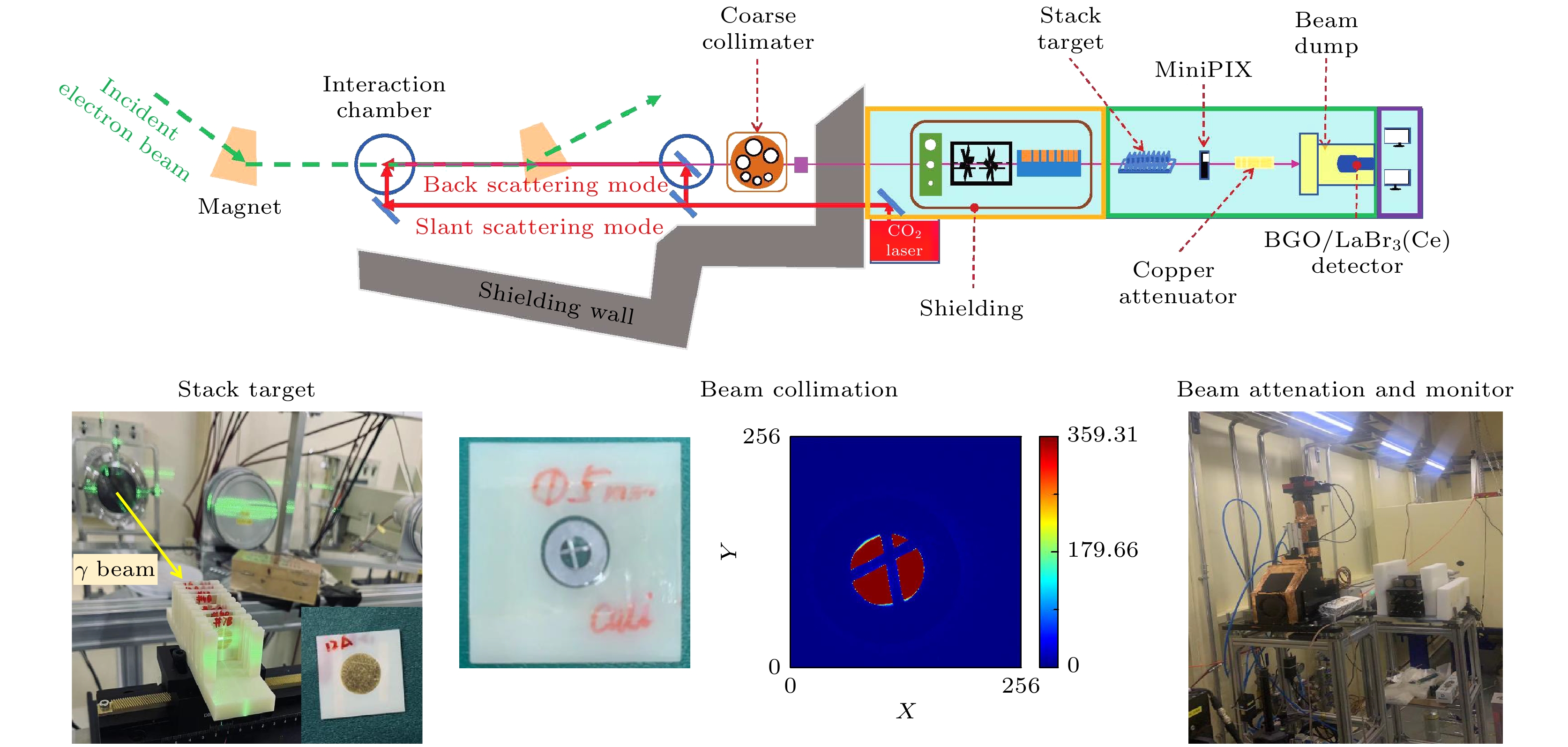
图 1 SLEGS束线站伽马活化实验布局示意图
Fig. 1. Schematic diagram of the SLEGS beamline and gamma activation Experimental layout.
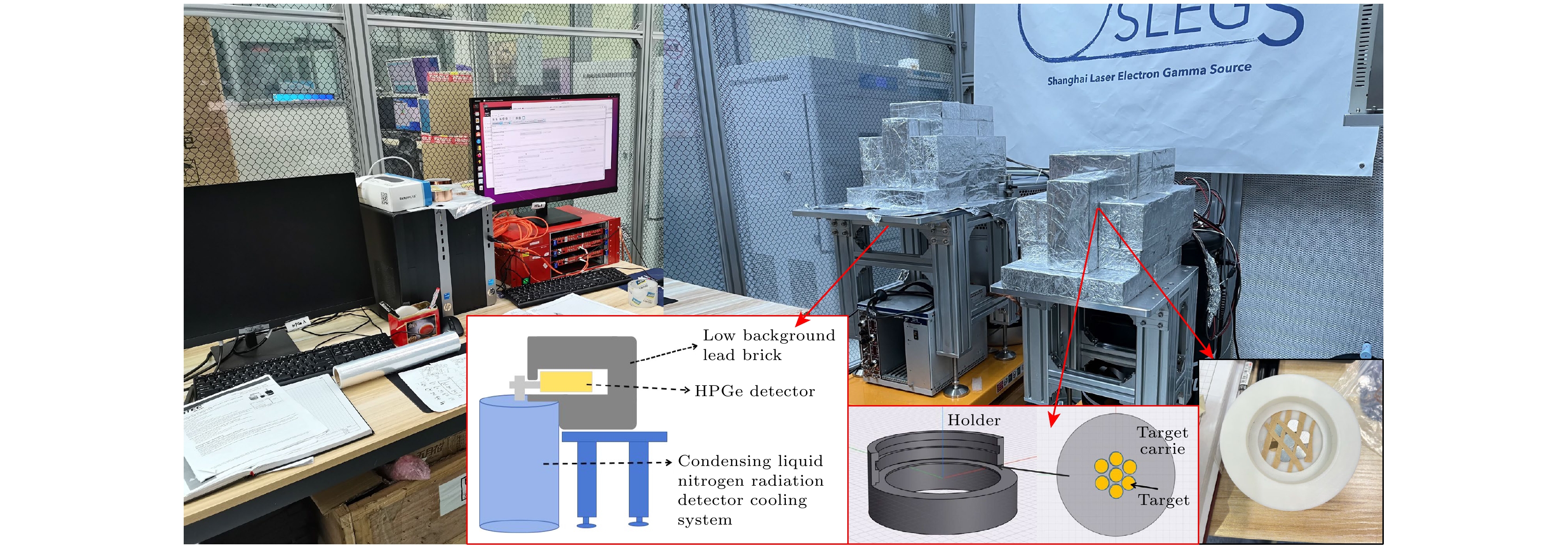
图 2 SLEGS伽马活化离线测量布局示意图
Fig. 2. Schematic diagram of the offline activation layout at the SLEGS beamline.
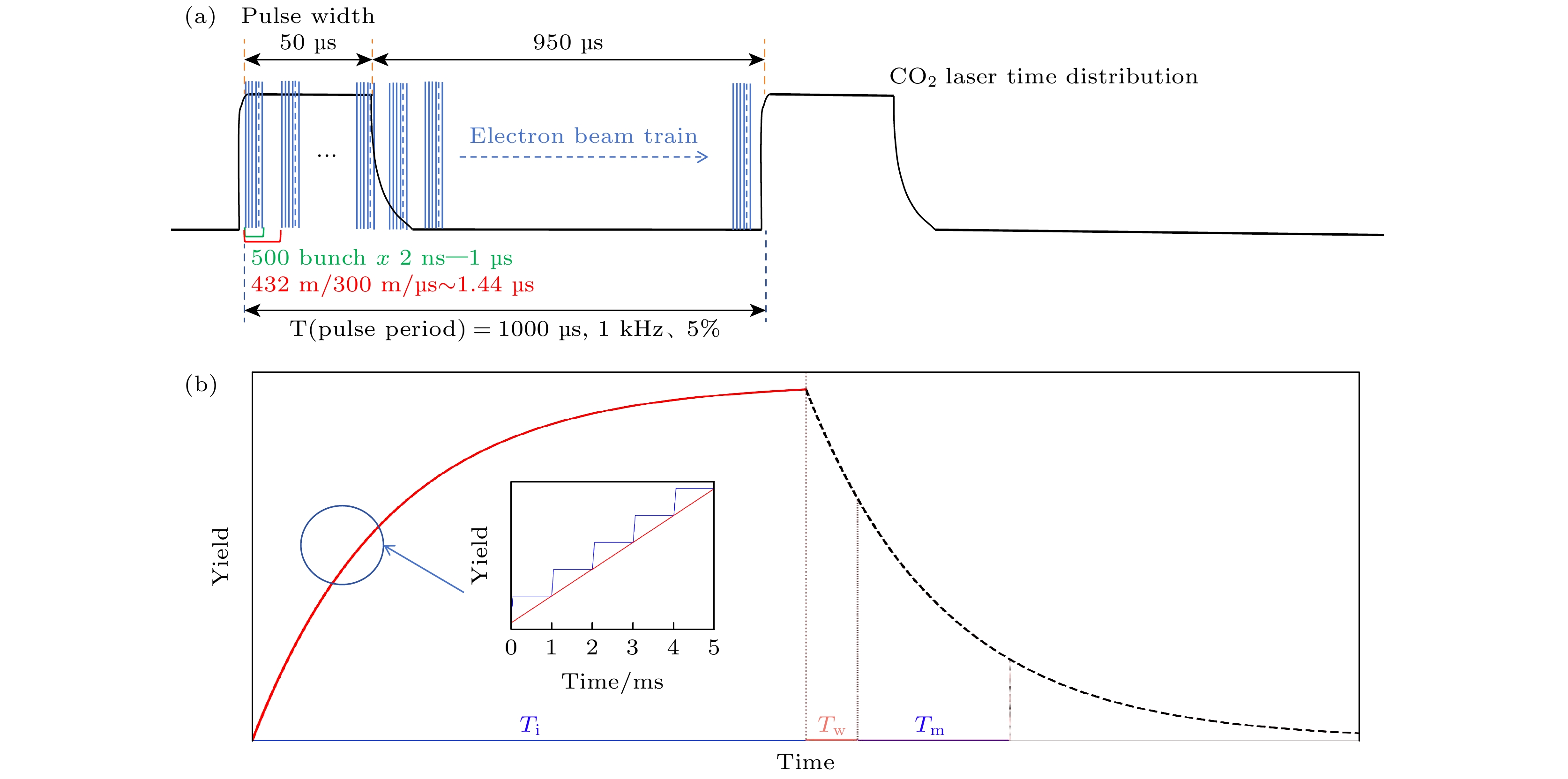
图 3 (a)SLEGS的束流时间分布谱与(b)伽马活化时间谱示意图
Fig. 3. (a)Schematic diagram of the beam time distribution spectrum and (b)gamma activation time spectrum of SLEGS
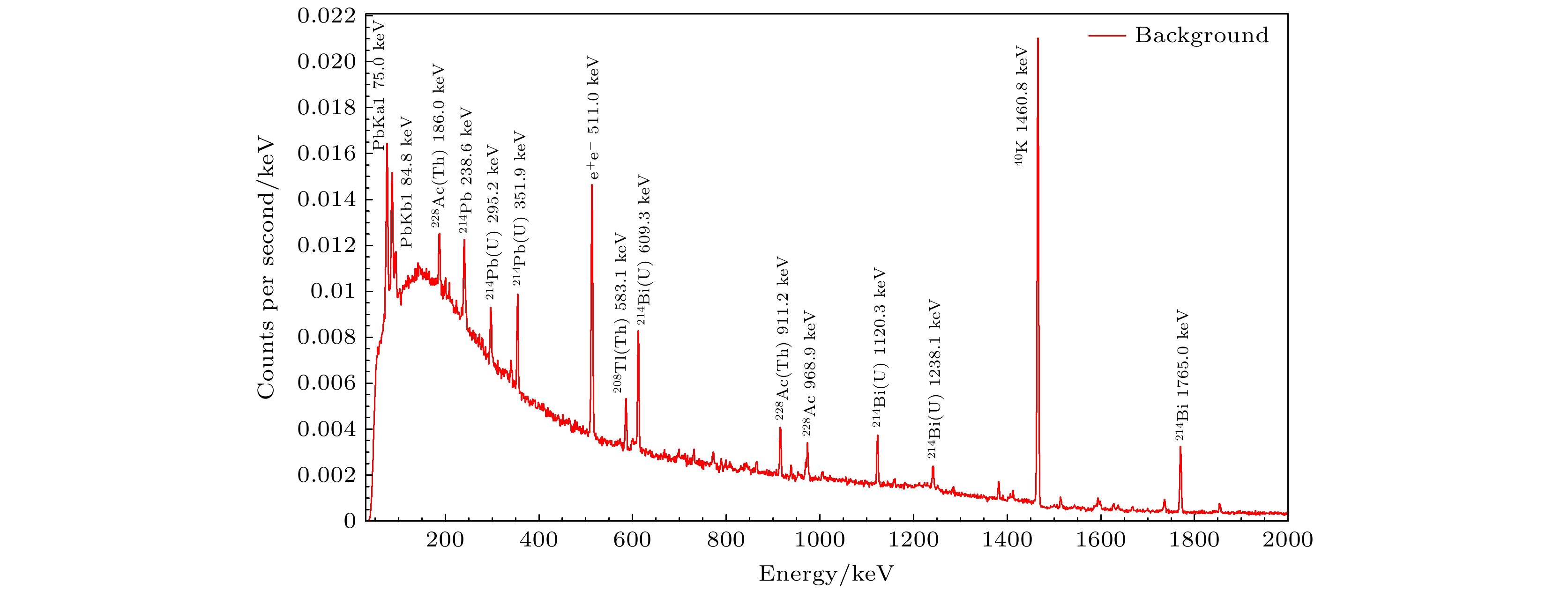
图 4 低本底屏蔽后测量天然本底能谱图(93小时)
Fig. 4. Natural background energy spectra after shielding (93 h)

图 5 (a) LaBr3(Ce)探测器测量伽马束能谱(黑实线)、LCS伽马能谱(红实线)与轫致辐射(Brem)伽马能谱(蓝实线); (b) 实测能谱(蓝实线)与蒙特卡洛重建谱(红虚线)、解谱得到的入射伽马能谱(绿实线)
Fig. 5. (a) The measured gamma beam spectrum by the LaBr3(Ce) detector(black solid line), LCS gamma spectrum component(red solid line); Bremsstrahlung(Brem)gamma spectrum(blue solid line). (b) Measured spectrum (blue solid line), Monte Carlo reconstruction (red dashed line); Unfolded true γ-ray spectrum(green solid line).

图 6 $ ^{197} {\rm{Au}}$、$ ^{64} {\rm{Zn}}$活化测量与LaBr3(Ce)直接测量、Geant4模拟流强结果对比
Fig. 6. Comparison of γ-ray beam flux results obtained from the $ ^{197} {\rm{Au}}$, $ ^{64} {\rm{Zn}}$ direct detection using LaBr3(Ce) scintillators, and Geant4 simulation results
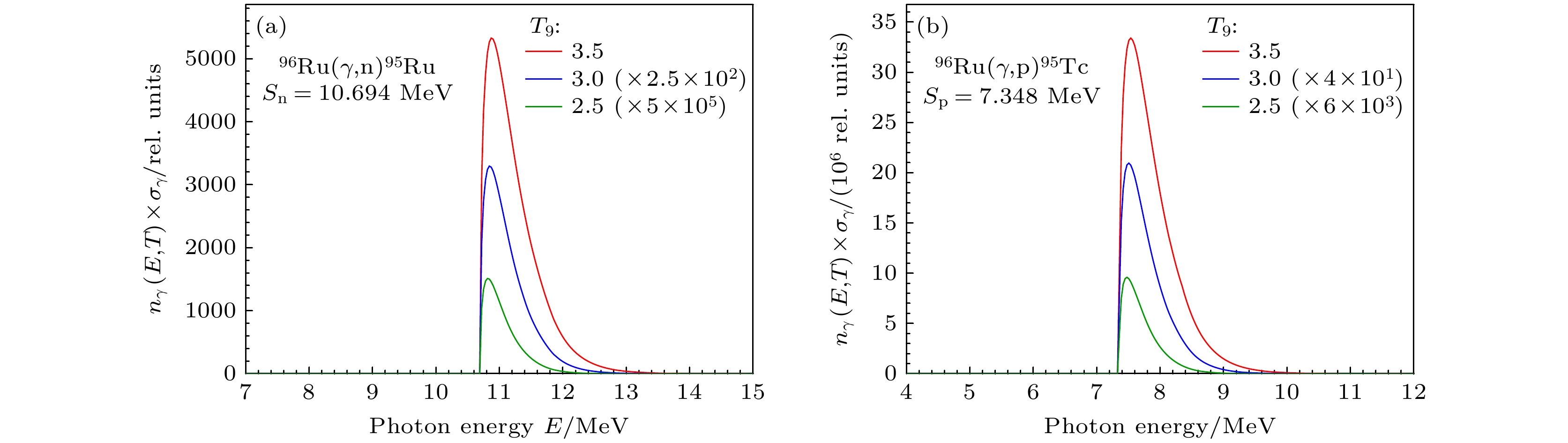
图 7 靶核基态伽莫夫窗口 (a) $ ^{96} {\rm{Ru}}$(γ, n), (b) $ ^{96} {\rm{Ru}}$(γ, p)
Fig. 7. Gamow window on the ground state of target nucleus (a) $ ^{96} {\rm{Ru}}$(γ, n), (b) $ ^{96} {\rm{Ru}}$ (γ, p)
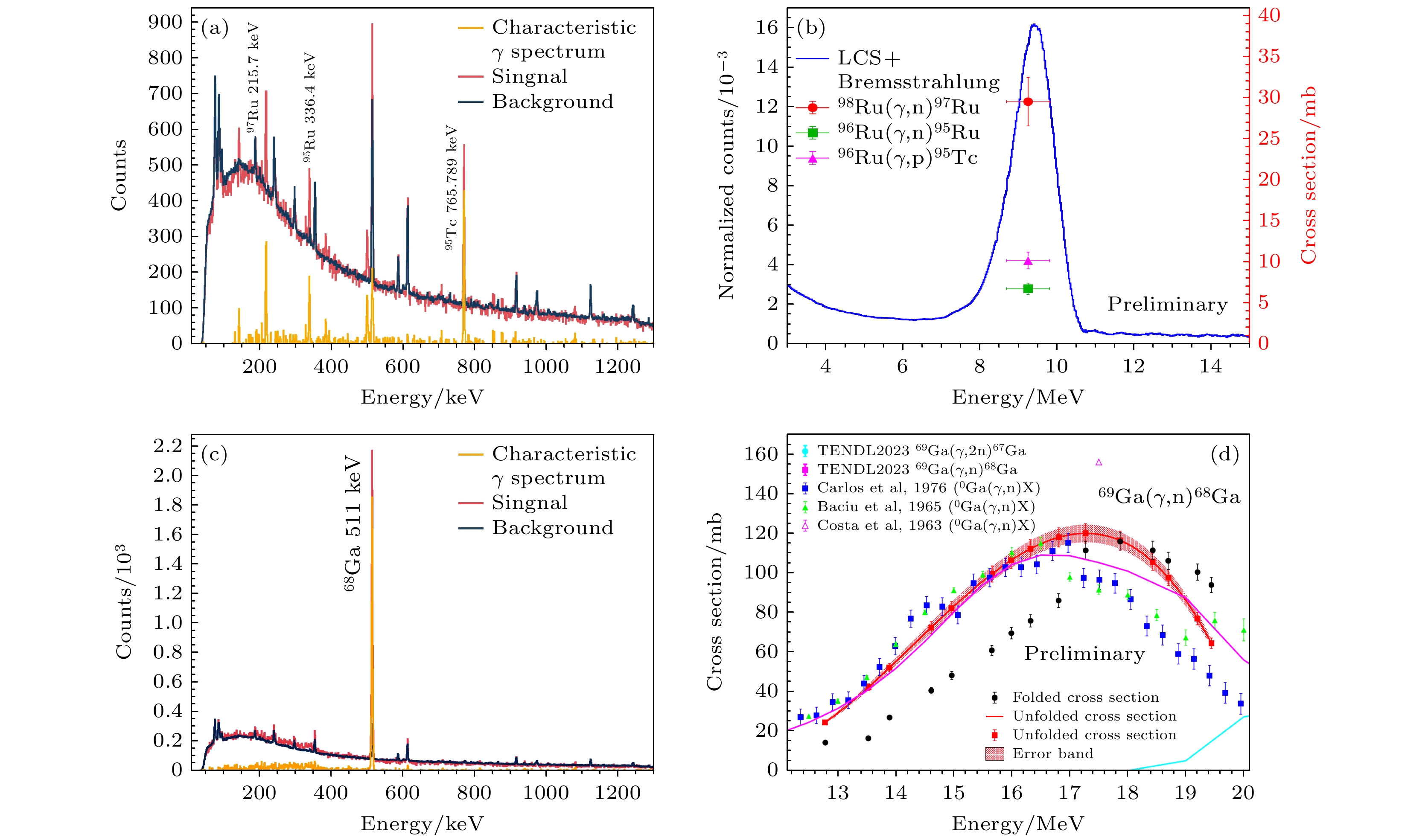
图 8 核天体物理相关的活化截面测量 (a, b) $ ^{Nat} {\rm{Ru}}$与(c, d) $ ^{Nat} {\rm{Ga}}$
Fig. 8. Activation cross section measurement of $ ^{Nat} {\rm{Ru}}$ (a, b) and $ ^{Nat} {\rm{Ga}}$ (c, d) in nuclear astrophysics
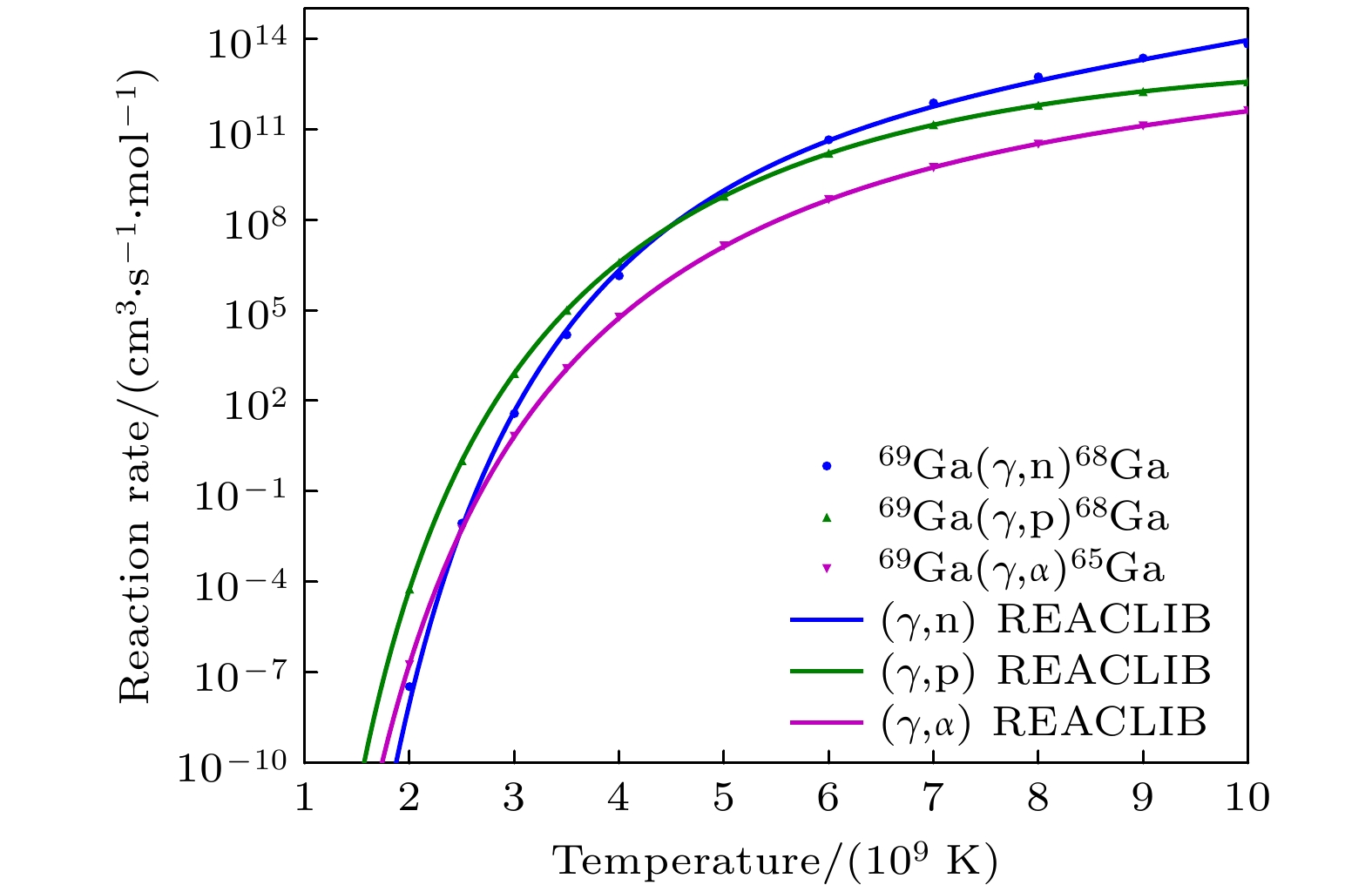
图 9 $ ^{69} {\rm{Ga}}$的核天体反应率
Fig. 9. Astrophysical reaction rates of $ ^{69} {\rm{Ga}}$
表 1 SSRF和SLEGS目前运行参数
Table 1. Operation parameters of SSRF and SLEGS
Parameter Value Description E-beam configuration
(ns/Bunch)2 SSRF E-beam energy (GeV) 3.5 SSRF E-beam current (mA) 180—210 Topup Mode CO2 Laser (μm) 10.64 Continue Mode Laser pulse width (μs) 50/950 On/Off Laser Power (W) 1—140 100 W, Average 5 W γ beam energy (MeV) 0.66—21.1, 21.7 20—160°, 180° γ beam spot (mm) 1—25 Selected by Collimator Energy Resolution 5—15% Resolution With Fine Collimator Total flux (γ/s) 4.8$ \times $$10 ^5 $—1.0$ \times $$10 ^7 $, 1.5$ \times $$10 ^7 $ 20—160°, 180°  下载: 导出CSV
表 2 ORTEC p型同轴高纯锗探测器参数
Table 2. ORTEC p-type coaxial high-purity germanium detector parameters
ORTEC GEM-50195-P GEM-70200-P 晶体直径(mm) 67.1 69.6 晶体长度(mm) 65.5 90.1 晶体死层(μm) 700 700 铝窗厚度(mm) 1.0 1.0 推荐高压(V) +2200 +2500 出厂分辨 1.69 keV@1.33 MeV
(0.13%)1.85 keV@1.33 MeV
(0.14%)目前分辨 4.53 keV@1.33 MeV
(0.34%)3.59 keV@1.33 MeV
(0.27%)探测效率 55.2%@1.33 MeV 74.2%@1.33 MeV 冷凝制冷 ${\rm{M}} \ddot{o} {\rm{bius}}$ LN-2
下载: 导出CSV
表 3 反应$ ^{69} {\rm{Ga}}$(γ, n)$ ^{68} {\rm{Ga}}$, $ ^{69} {\rm{Ga}}$(γ, p)$ ^{68} {\rm{Zn}}$及$ ^{69} {\rm{Ga}}$(γ, α)$ ^{65} {\rm{Cu}}$推荐的REACLIB参数
Table 3. Recommended REACLIB parameters for $ ^{69} {\rm{Ga}}$(γ, n)$ ^{68} {\rm{Ga}}$, $ ^{69} {\rm{Ga}}$(γ, p)$ ^{68} {\rm{Zn}}$ and $ ^{69} {\rm{Ga}}$(γ, α)$ ^{65} {\rm{Cu}}$
Reaction $ a_0 $ $ a_1 $ $ a_2 $ $ a_3 $ $ a_4 $ $ a_5 $ $ a_6 $ 拟合误差 (γ, n) 100.0 $ -100.0 $ $ -100.0 $ 24.17343 $ -8.81476 $ 0.86009 $ -6.64832 $ 9.07% (γ, p) $ -99.9999995 $ $ -95.31730 $ 47.22335 99.99999997 $ -8.88088 $ 0.44241 $ -13.29059 $ 0.00 (γ, α) $ -100.0 $ $ -87.00958 $ 34.26290 100.0 $ -11.21949 $ 0.70231 $ -7.09431 $ 0.10%
下载: 导出CSV
-
[1] Segebade C, Berger A 2008 Photon Activation Analysis (Encyclopedia of Analytical Chemistry R.A. Meyers (Ed.)
[2] Segebade C, Starovoitova V N, Borgwardt T, Wells D 2017 J Radioanal Nucl Chem 312 443
 Google Scholar
[3] Gaudin A M, Pannell J H Anal. Chem. 23 1261
[4] Erhard M A 2013 Photoaktivierung des p-Kerns 92Mo am Bremsstrahlungsmessplatz von ELBE. Ph.D. Dissertation, Dresden, Techn. Univ., Diss., 2010
[5] Avino P, Capannes G, Lopez F, Rosada, A 2013 Sci. World J. 458793 1
[6] Tai R Z, Zhao Z T 2022 J. Phys.: Conf. Ser. 2380 012004
Google Scholar
[7] Tai R Z, Zhao Z T 2024 Nucl. Sci. Tech. 35 137
Google Scholar
[8] 王宏伟, 范功涛, 刘龙祥, 曹喜光, 李薇, 张岳, 胡新荣, 李鑫祥, 王俊文, 鲁同所, 黄勃松, 郝子锐, 匡攀, 黄玉华 2020 原子核物理评论 37 53
Wang H W, Fan G T, Liu L X, Cao X G, Li W, Zhang Y, Hu X R, Li X X, Wang J W, Lu T S, Huang B S, Hao Z R, Kuang P, Huang Y H 2020 Nucl. Phys. Rev. 37 53
[9] Wang H W, Fan G T, Liu L X, Xu H H, Shen W Q, Ma Y G, Utsunomiya H, Song L L, Cao X G, Hao Z R, Chen K J, Jin S, Yang Y X, Hu X R, Li X X, Kuang P 2022 Nucl. Sci. Tech. 33 87
Google Scholar
[10] Liu L X, Wang H W, Fan G T, Xu H H, Zhang Y, Hao Z R, Li A G 2024 Nucl. Sci. Tech. 35 111
Google Scholar
[11] Hao Z R, Fan G T, Wang H W, Liu L X, Xu H H, Utsunomiya H, Cao X G, Xu B J, Song L L, Hu X R, Li X X, Yang Y X, Kuang P 2021 Nucl. Instrum. Methods Phys. Res. A 1013 165638
Google Scholar
[12] Z-R H, G-T F, H-W W, H-H X, L-X L, L-L S, X-R H, X-X L, P K, S J 2022 Nucl. Instrum. Methods Phys. Res. B 519 9
Google Scholar
[13] Xu H H, Fan G T, Wang H W, Utsunomiya H, Liu L X, Hao Z R, Wu H L, Song L L, Zhang Q L, Jiang B C, Hu X R, Li X X, Kuang P, Yang Y X, Jin S 2022 Nucl. Instrum. Methods Phys. Res. A 1033 166742
Google Scholar
[14] 杨宇萱, 张岳, 赵维娟, 王宏伟, 范功涛, 许杭华, 刘龙祥, 郝子锐, 李志才, 金晟, 陈开杰, 焦普, 周梦蝶, 王振伟 2024 原子核物理评论 41 433
YANG Y X, ZHANG Y, ZHAO W J, WANG H W, FAN G T, XU H H, LIU L X, HAO Z R, LI Z C, JIN S, CHEN K J, JIAO P, ZHOU M D, WANG Z W 2024 Nucl. Phys. Rev. 41 433
[15] YANG Y X, ZHANG Y, LI Z C, HAO Z R, JIN S, CHEN K J, WANG Z W, SUN Q K, FAN G T, XU H H, LIU L X, ZHAO W J, WANG H W 2025 Nucl. Sci. Tech. 36 80
Google Scholar
[16] Li Z C, Yang Y, Cao Z W, Li X X, Yuan Y, Zhao Z Q, Fan G T, Wang H W, Luo W 2023 Nucl. Sci. Tech. 34 170
Google Scholar
[17] Li Z C, Yang Y X, Luo W, Fan G T, Wang H W, Liu L X, Hao Z R, Xu H H, Li X X, Yuan Y, Zhang Y, Jin S, Chen K J, Jiao P, Zhou M D, Wang Z W, Sun Q K, Ye S, Xu R R, He C Y 2025 Nucl. Instr. and Meth. B 559 165595
Google Scholar
[18] 张昊, 张立勇, 何建军, 马余刚 2025 中国科学: 物理学力学天文学 55 250005
Zhang H, Zhang L Y, He J J, Ma Y G 2025 Sci. Sin. Phys. Mech. Astron. 55 250005
[19] Pang X, Sun B H, Zhu L H, Lu G H, Zhou H B, Yang D 2023 Nucl. Sci. Tech. 34 187
Google Scholar
[20] Yang Y X, Zhao W J, Cao X G, Wang H W, Fan G T, Liu L X, Xu H H, Hu X R, Li X X, Hao Z R, Jin S, Chen K J, Ma Y G 2024 Radiat. Phys. Chem. 218 111599
Google Scholar
[21] Sun Z J 2018 Nucl. Sci. Tech. 29 155
Google Scholar
[22] Liu L X, Utsunomiya H, Fan G T, Xu H H, Wang H W, Hao Z R, Zhang Y, He C Y, Jiao P, Ye S, Jin S, Chen K J, Yang Y X, Sun Q K, Wang Z W, Li Z C, Zhou M D, Lu X, Yang C, Lu F, Cao X G 2024 Nucl. Instrum. Methods Phys. Res., A 1063 169314
Google Scholar
[23] Hao Z R, Fan G T, Wang H W, Liu L X, Xu H H, Zhang Y, Yang Y X, Jin S, Chen K J, Li Z C, Jiao P, Sun Q K, Zhou M D, Ye S, Wang Z W, Shen W Q, Ma Y G 2025 Sci. Bull. 70 2591
Google Scholar
[24] Arnould M, Goriely S 2003 Phys. Rep. 384 1
Google Scholar
[25] Rayet M, Arnould M, Hashimoto M, Prantzos N, Nomoto K 1995 Astron. Astrophys. 298 517
[26] Travaglio C, R?pke F, Gallino R, Hillebrandt W 2011 Astrophys. J. 739 93
Google Scholar
[27] Dietrich S S, Berman B L 1988 At. Data Nucl. Data Tables 38 199
Google Scholar
[28] Vogt K, Mohr P, Babilon M, Bayer W, Galaviz D, Hartmann T, Hutter C, Rauscher T, Sonnabend K, Volz S, Zilges A 2002 Nucl. Phys. A 707 241
Google Scholar
[29] Goko S, Utsunomiya H, Goriely S, Makinaga A, Kaihori T, Hohara S, Akimune H, Yamagata T, Lui Y W, Toyokawa H, Koning A J, Hilaire S 2006 Phys. Rev. Lett. 96 192501
Google Scholar
[30] Koning A, Hilaire S, Goriely S 2023 Eur. Phys. J. A 59 131
Google Scholar
[31] Rauscher T, Thielemann F K 2000 At. Data Nucl. Data Tables 75 1
Google Scholar
[32] Reimers P, Lutz G J, Segebade C 1977 J. Radioanal. Chem. 39 93
Google Scholar
[33] Borgwardt T C 2018 Proceedings: 1 st International Electronic Conference on Geosciences, (IECG 2018) 564 1
[34] Sun Z J, Wells D P, Segebade C, Maschner H, Benson B 2013 J Radioanal Nucl Chem 296 293
Google Scholar
[35] Sun Z J, Okafor K, Isa S 2017 Appl. Radiat. Isot. 127 173
Google Scholar
[36] 孙远明, 许旭, 唐婉月, 常艺, 陆景彬, 赵龙, 刘玉敏 2019 物理学报 68 1082801
Sun Y M, Xu X, Tang W Y, Chang Y, Lu J B, Zhao L, Liu Y M 2019 Acta Phys. Sin 68 1082801
[37] Sun X J, Zhou F Q, Song Y L, Li Y, Ji P F, Chang X Y 2019 Chin. Phys. Lett. 36 112501
Google Scholar
[38] 贺书凯, 齐伟, 矫金龙, 董克攻, 邓志刚, 滕建, 张博, 张智猛, 洪伟, 张辉, 沈百飞, 谷渝秋 2018 物理学报 67 225202
Google Scholar
He S K, Qi W, Jiao J L, Dong K G, Deng Z G, Teng J, Zhang B, Zhang Z M, Hong W, Zhang H, Shen B F, Gu Y Q 2018 Acta Phys. Sin. 67 225202
Google Scholar
[39] Li Z C, Hao Z R, Sun Q K, Shen Y L, Liu L X, Xu H H, Zhang Y, Jiao P, Zhou M D, Yang Y X, Jin S, Chen K J, Wang Z W, Ye S, Li X X, Ma C W, Wang H W, Fan G T, Luo W 2025 Nucl. Sci. Tech. 36 34
Google Scholar
[40] Zhou M D, Hao Z R, Sun Q K, Liu L X, Xu H H, Zhang Y, Jiao P, Li Z C, Luo W, Yang Y X, Jin S, Chen K J, Ye S, Wang Z W, Wang Y T, Wei H L, Fu Y, Yu K, Wang H W, Fan G T, Ma C W 2025 Phys. Rev. C 111 054612
Google Scholar
[41] Jiao P, Hao Z R, Sun Q K, Liu L X, Xu H H, Zhang Y, Zhou M D, Li Z C, Luo W, Yang Y X, Jin S, Chen K J, Ye S, Wang Z W, Wang Y T, Wei H L, Fu Y, Yu K, Wang H W, Fan G T, Ma C W 2025 Nucl. Sci. Tech. 36 66
Google Scholar
[42] 匡攀, 宋龙龙, 陈开杰, 王宏伟, 刘龙祥, 范功涛, 许杭华, 胡新荣, 李鑫祥, 郝子锐, 杨宇萱, 金晟 2023 原子核物理评论 40 2022040
Pan K, Long-Long S, Kai-Jie C, Hong-Wei W, Long-Xiang L, Gong-Tao F, Hang-Hua X, Xin-Rong H, Xin-Xiang L, Zi-Rui H, Yu-Xuan Y, Sheng J 2023 Nucl. Phys. Rev. 40 2022040
[43] 郝子锐, 范功涛, 刘龙祥, 王宏伟, 张岳, 胡新荣, 李鑫祥, 王俊文, 匡攀, 戈松雨 2020 核技术 43 110501
Hao Z R, Fan G T, Liu L X, Wang H W, Zhang Y, Hu X R, Li X X, Wang J W, Kuang P, Ge S Y 2020 Nucl. Tech. 43 110501
[44] Hao Z R, Liu L X, Zhang Y, Wang H W, Fan G T, Xu H H, Jin S, Yang Y X, Li Z C, Jiao P, Chen K J, Sun Q K, Wang Z W, Zhou M D, Ye S, Xu M K, Wang X F, Shen Y L 2025 Nucl. Sci. Tech. 36 183
Google Scholar
[45] Chen K J, Liu L X, Hao Z R, Ma Y G, Wang H W, Fan G T, Cao X G, Xu H H, Niu Y F, Li X X, Hu X R, Yang Y X, Jin S, Kuang P 2023 Nucl. Sci. Tech. 34 47
Google Scholar
[46] Jin S, Hao Z R, Liu L X, Chen K J, Yang Y X, Xu H H, Zhang Y, Sun Q K, Wang Z W, Fan G T, Wang H W 2025 Nucl. Sci. Tech. 34 78
[47] Liu P, Zhang H Y, Wu X F, Xu R R, Tao X, Tian Y, Jin Y L, Wang J M, Zhang Z, Ge Z G, Shu N C 2024 Ann. Nucl. Energy 208 110745
Google Scholar
[48] 谢金辰, 陶曦, 续瑞瑞, 田源, 邢康, 葛智刚, 牛一斐 2025 物理学报 74 082501
Google Scholar
Xie J C, Tao X, Xu R R, Tian Y, Xing K, Ge Z G, Niu Y F 2025 Acta Phys. Sin. 74 082501
Google Scholar
[49] Mirani F, Calzolari D, Formenti A, Passoni M 2021 4 185

 下载:
下载:
计量
- 文章访问数: 201
- PDF下载量: 5
- 被引次数: 0
